



The Indian judicial system stands at a precarious crossroads. While the overarching edifice of the Supreme Court and High Courts commands respect, the foundation—justice delivery for the common man—is crumbling under the weight of insurmountable delays. It is high time we interrogate the very soul of our legal framework: is it truly Indian, or merely a colonial artifact struggling to govern a civilizational state? The answer lies in revisiting the conflict between the imported concept of Legal Justice and the indigenous, eternal principle of Dharmic Justice.
5 Crore+
Cases Pending Across Courts
75%
Prisoners are Undertrials
The Illusion of Justice in the Modern State
The stated purpose of any judicial system is to uphold the rule of law, resolve disputes, and maintain social order. In post-independence India, we adopted a model that promised equality and fairness through codified statutes and procedural rigour. Theoretically, this system is designed to be the ultimate arbiter of truth. However, the reality on the ground paints a starkly different picture. The modern Indian court system has become synonymous with "process" rather than "justice." It is a labyrinth of adjournments, technicalities, and prohibitive costs that alienates the very citizen it seeks to protect.
The centralization of justice has turned the litigant into a mere number in a chaotic registry. We have built courthouses of concrete, yet the spirit of resolution is absent.
"The ultimate question that haunts the corridors of our legal institutions today is singular and uncomfortable: Is the purpose of justice actually being fulfilled? When a land dispute takes three generations to resolve... the system is structurally failing."
When a land dispute takes three generations to resolve, or a petty crime turns a youth into a hardened criminal due to delayed trials, one must conclude that the system is not merely struggling; it is structurally failing to deliver on its promise.
The Colonial Shackles: Why the System Failed
The core reason for this systemic failure is not merely administrative inefficiency; it is a fundamental misalignment between the Indian ethos and the Western legal framework. The current judicial architecture is a direct inheritance from the British Raj, specifically designed not to serve the people, but to control them.
The British systematically dismantled India's indigenous, decentralised justice delivery mechanisms. It is a profound irony that a civilisation which managed its affairs for millennia through self-regulated communities was forced into a highly centralised system where Delhi or London became the ultimate arbiters of village disputes. The British replaced the concept of Dharma (righteous duty and cosmic order) with the concept of "Legality."
| Feature | Colonial / Legal Justice | Dharmic / Restorative Justice |
|---|---|---|
| Core Concept | State vs. Individual (Punitive) | Harmony & Cosmic Order (Restorative) |
| Objective | Incarceration & Punishment | Restitution & Social Reintegration |
| Administrator | Centralized State (Distant Judge) | Decentralized Community (Local Elders) |
| Outcome | Isolation & Recidivism | Atonement & Social Balance |
Furthermore, they introduced a rigid, punitive Dand-Vidhan (Penal Code) that prioritised incarceration over resolution. In the Western model, a crime is an offence against the State; in the Indian model, it was a disruption of social harmony.
The Wisdom of Antiquity: Governance by Dharma
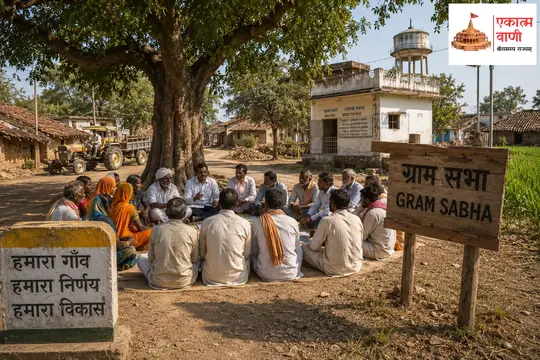
To understand the solution, one must rationally analyse how justice was administered in Ancient India. Contrary to the colonial narrative of "despotism," India possessed a sophisticated, highly decentralised network of justice that was accessible, swift, and cost-effective.
The governance of justice was bifurcated effectively:
Village Assemblies
These bodies handled civil matters, land disputes, and resource allocation. The adjudicators were local elders who knew the context, geography, and history of the disputing parties.
Social Councils
These dealt with social norms, matrimonial issues, and community conduct. Decisions were enforced by the collective moral weight of the community, not state force.
Decisions in these forums were not enforced by the barrel of a gun but by the collective moral weight of the community. For instance, in the Chola administration, the Ur and Sabha assemblies had the autonomy to settle disputes without state interference. The concept of Restorative Justice was paramount; the goal was not to punish the sinner but to erase the sin and restore the relationship.
Beacons of Restorative Justice
History and even contemporary tribal practices offer gleaming examples of this approach. In the Mauryan Era, as detailed in Kautilya’s Arthashastra, judges (Dharmasthas) were tasked with seeking truth through investigation and reconciliation, not just procedural hearings. The King was the final appellate authority, but the bulk of litigation never left the village.
Even today, we see glimmers of this in the Alternative Dispute Resolution (ADR) mechanisms and Lok Adalats. True success stories are found in the tribal belts of Central India and the North East, where customary laws still prevail. Here, disputes that would clog a High Court for decades are resolved in a day through community mediation.
Insights from Ekatma Manav Darshan
The philosophy of Ekatma Manav Darshan (Integral Humanism), propounded by Pt. Deendayal Upadhyaya, offers a profound theoretical basis for this shift. Upadhyaya ji argued that the Western view views the individual and the State in a constant tussle for power, leading to a rights-based litigious society. In contrast, the Bharatiya view sees the individual, society, nature, and the divine as an integrated whole.
The Philosophy of Integration
According to this philosophy, justice cannot be "delivered" by the State alone; it must be "lived" by the society. The legal system must align with the Chiti (National Soul) of India. A system based on Ekatma Manav Darshan prioritizes Vikendrikaran (Decentralization), empowering the smallest unit of society to resolve its own conflicts.
The Statistical Reality: A Case for Reform
The data supporting the need for this paradigm shift is undeniable. If we were to create a visual representation of the current crisis, the inputs would be staggering.
Fig 1: The 'Undertrial Tragedy' - 75% of prisoners have not been convicted.
Fig 2: Relative burden of Cost and Time: Modern vs Traditional Systems.
The Pendency Crisis and the Undertrial Tragedy are direct results of a procedural, punitive system. While traditional Panchayat justice had a near-zero financial cost, the current legal process consumes a significant percentage of a common man's lifetime earnings.
Conclusion: A Return to Roots for a Better Future
In summary, the current crisis in the Indian judiciary is self-inflicted—a result of clinging to a foreign, centralised, and punitive legal framework that is incompatible with the Indian ethos. The irony of a civilisation that taught the world the meaning of Nyaya now struggling for basic justice is palpable.
The Path Forward
To reduce the burden on our courts, the State must stop looking West for solutions. By shifting the focus from incarceration to social correction, and from centralisation to empowerment, we can reclaim a justice system that is not only efficient but also morally resonant with the soul of Bharat.


 Continue With Google
Comments (0)