
The Illusion of Autonomy: Beyond the 73rd and 74th Amendments
For decades, the political discourse in India has lauded the 73rd and 74th Constitutional Amendments as the watershed moments for democracy. While these amendments undoubtedly formalised the three-tier structure of governance, creating a framework for the Panchayati Raj, a rigorous analysis reveals a hollow victory. We have created the skeleton of democracy in our villages, but we have denied it the lifeblood—financial and resource sovereignty.
Figure 1: The Dependency Trap. Current fiscal data indicates that Panchayats are overwhelmingly dependent on tied grants from State/Central governments, leaving minimal room for autonomous development.
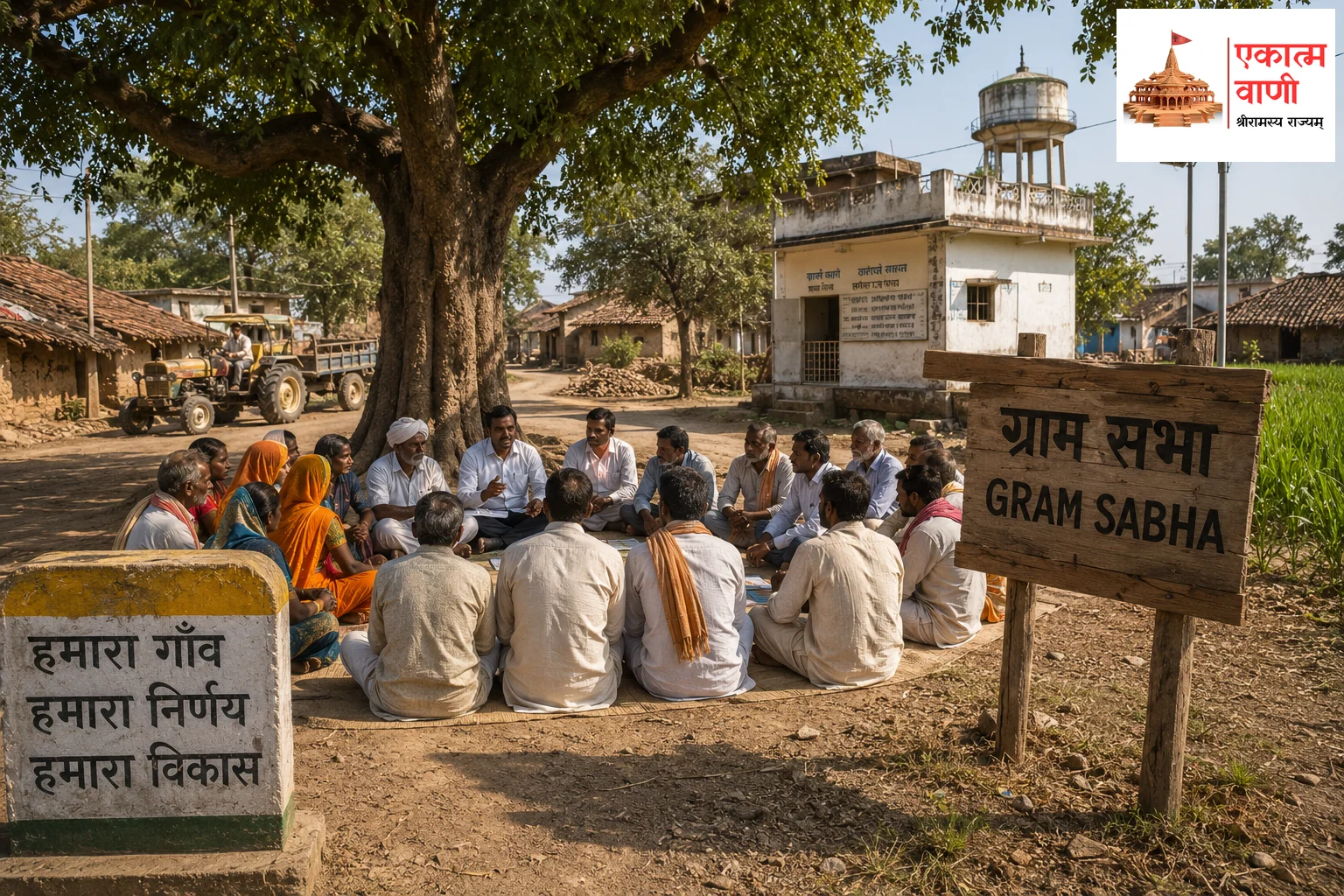
The current structure treats the Gram Sabha not as a parliament of the village, but as a last-mile implementation agency for schemes hatched in the air-conditioned corridors of Delhi. The narrative of "decentralisation" has been reduced to the mere act of holding elections every five years. However, true Swaraj is not merely electoral; it is economic. Currently, a Sarpanch acts less like a village prime minister and more like a petitioner to the District Collector. The financial strings—the power to allocate, utilise, and manage local resources (jal, jangal, zameen)—remain firmly in the grip of the administrative bureaucracy.
The Colonial Hangover: Why the Purpose Remains Unfulfilled
The reason for this systemic failure lies not in a lack of capability in rural Bharat, but in the persistent, suffocating grip of a colonial administrative mindset. Our policy execution is still heavily influenced by Western thought processes that view the state as the supreme provider and the citizen as a mere beneficiary. This is the legacy of the British Raj, which designed the Indian bureaucracy (the "Steel Frame") to control the natives, not to empower them.
Cultural Reflection: The 'Panchayat' Lens
There is a poignant scene in the popular web series Panchayat that inadvertently exposes this civilizational fault line. In the scene, the District Magistrate (Collector) reprimands the Sarpanch and the village secretary for not knowing the National Anthem. On the surface, it seems like a patriotic rebuke. However, viewed through a nationalist lens, it reflects the arrogance of the English-speaking administrative class towards rural leadership. It reminds us of that deep-seated "Macaulay mindset" where the administration is paramount, and our villages are viewed as repositories of stupidity, backwardness, and poverty.
This mindset assumes that a villager in Gadarwara or Kesla cannot possibly know what is best for their land; that wisdom resides only in files and English circulars. This disconnect is the core reason why decentralisation fails. We have ignored the indigenous capacity for governance, assuming that the Westernised bureaucrat is the civilising agent for the "unruly" village.
The Wisdom of the Ancients: Governance in Historic Bharat
To understand true decentralisation, one must look back to ancient Bharat, long before the chaos of invasions disrupted our social fabric. In the Vedic and Mauryan eras, and specifically under the Chola administration, the village was a self-contained republic—a Janapada.
| Feature | Modern Bureaucracy (British Legacy) | Ancient Janapada (Chola/Vedic) |
|---|---|---|
| Role of Village | Implementation Agency | Self-Contained Republic |
| Resource Control | State/District Controlled | Community Owned (Sabha) |
| Decision Making | Top-Down (Delhi to Village) | Consensus-Based (Desha-Dharma) |
| King/State Role | Micromanagement | Protection & Dharma Only |
Historical records, such as the Uthiramerur inscriptions, detail a system where the Sabha (assembly) had absolute authority over land usage, water distribution, and tax collection. The King’s role was limited to protection and upholding Dharma; he did not micromanage the village tank. In ancient India, decentralisation was not a "gift" from the Centre; it was the natural order of existence.
Beacons of Resilience: Lessons from the Soil
Despite the bureaucratic stranglehold, the spirit of the Janapada survives where communities have dared to reclaim their agency. In my fieldwork and observation of regions like Gadarwara and Kesla in Madhya Pradesh, one witnesses the latent potential of rural Bharat.
Figure 2: The Bureaucratic Bottleneck (Gadarwara Analysis). This chart illustrates the discrepancy between funds requested by the Gram Sabha for local development versus the actual funds approved by the district administration, highlighting the "leaking pipe" of resource allocation.
In these regions, despite administrative apathy, community cohesion remains the driving force. In Kesla, specifically, interventions that focused on empowering the tribal population to manage their own produce rather than relying on state handouts showed significant promise. When the Gram Sabha is active—not just on paper but in spirit—villages transform. The success stories in these belts are not due to government generosity, but due to local leadership asserting its rights over local resources.
Ekatma Manav Darshan: The Philosophical Basis for Autonomy
The Paradigm Shift: Integral Humanism
Current Model
Unit of Planning: Central Commission
Focus: GDP & Individualism
Proposed Model
Unit of Planning: The Village (Janapada)
Focus: Antyodaya & Organic Whole
"If the Chiti (soul) of the nation resides in its villages, then stifling the village economically is akin to strangling the nation’s soul." — Deendayal Upadhyaya
The path forward must be illuminated by our own indigenous philosophy, specifically the Ekatma Manav Darshan (Integral Humanism) propounded by Pandit Deendayal Upadhyaya. Unlike Western capitalism, which champions unbridled individualism, or Communism, which champions state control, Ekatma Manav Darshan views society as an organic whole.
Deendayal-ji argued that Arthayam (economic structure) must be decentralised. He believed that "economic power should be shared." According to this philosophy, the unit of economic planning should not be the centralised Planning Commission, but the village. Applying this to our current context: The Gram Sabha must be the primary unit of economic planning. The "Antyodaya" (rise of the last person) cannot happen if the resources intended for the last person are filtered through a leaking bureaucratic pipe. True Integral Humanism demands that the village becomes a unit of production and consumption, distinct from the globalised, urban-centric supply chains that exploit rural resources without fair compensation.
The Data of Disparity: Visualising the Imbalance
To understand the gravity of the situation, we must look at the asymmetry in power and resources. The administrative discretion currently embedded in the system creates a massive power imbalance.
Figure 3: Administrative Discretion Index. A comparative visualization showing the exponential difference in project sanctioning authority between a District Collector and an elected Sarpanch.
Financial Autonomy: Currently, over 90% of a Panchayat’s funds come from Central or State grants (tied funds). Less than 5-10% is Own Source Revenue (OSR). This makes them beggar institutions.
Conclusion: From Yachak to Swabhimani
The 73rd Amendment was a necessary start, but it was merely the laying of the foundation. The house of Gram Swaraj remains unbuilt because the keys are still held in the district headquarters. We must reject the Westernised notion that centralised bureaucracy equals efficiency. The scene from Panchayat should not just be entertainment; it should be a wake-up call to the indignity we heap upon our rural leaders.
To make Bharat a global superpower, we do not need to turn our villages into smart cities; we need to turn them into smart Janapadas. The Gram Sabha must evolve from being a Yachak (petitioner/beggar) to a Swabhimani (self-respecting) entity. This requires a legislative overhaul that grants Gram Sabhas the legal right to collect taxes, manage mineral resources, and veto projects that harm their ecology.
We must empower the Gram Sabha to be the first and most crucial ladder of our democracy. Only when the village stands tall, independent, and proud, will the true spirit of ancient Bharat be restored.
Keywords:
 Continue With Google
Comments (0)