
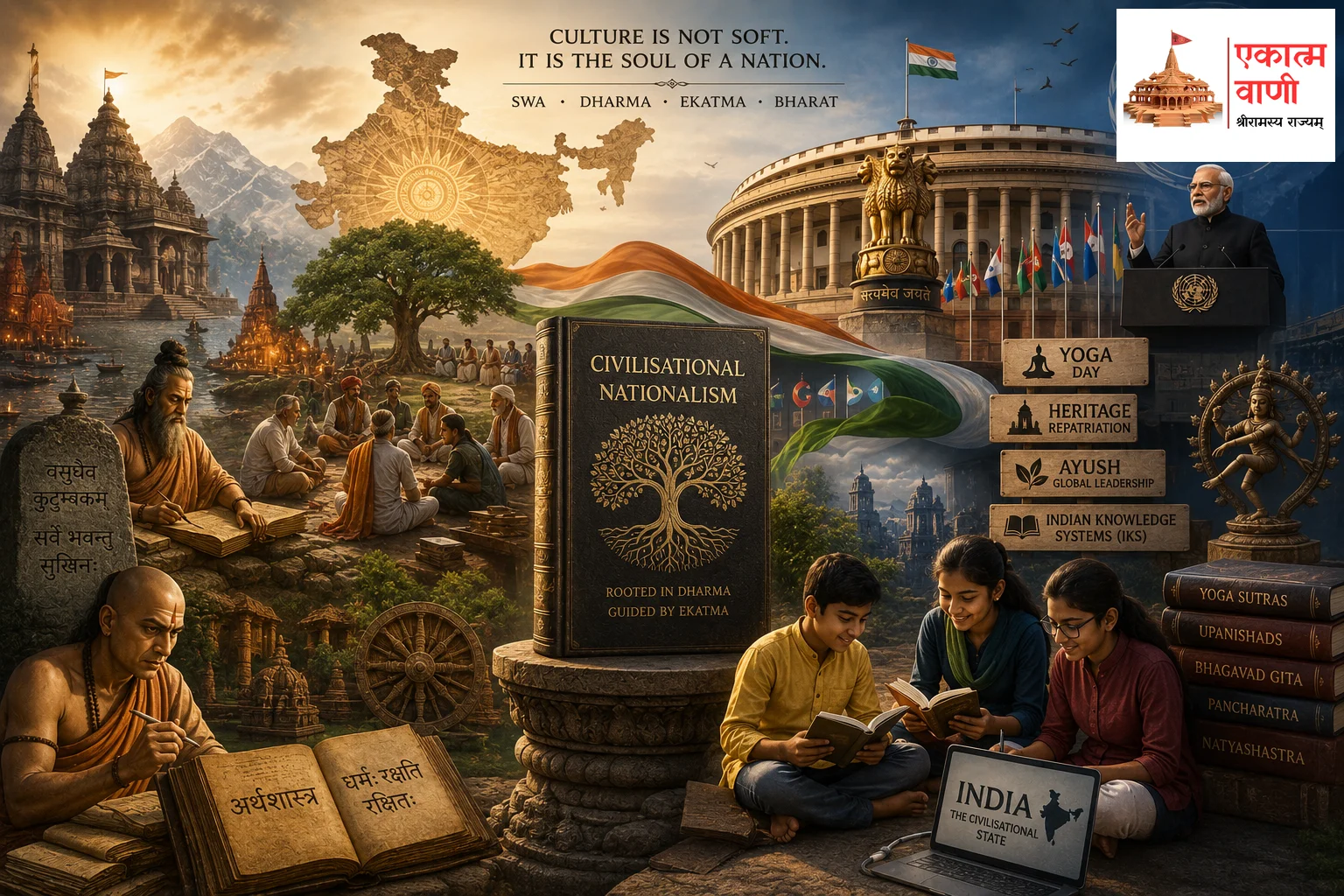
For nearly seven decades following independence, the Indian state operated under a borrowed constitution of thought, one that viewed the nation through a colonial prism. The modern narrative often reduces culture to a mere diplomatic tool—what the West patronisingly terms 'Soft Power'. However, a resurgence is visible. There is a palpable shift in the corridors of power, from the Ministry of External Affairs to the classrooms shaped by the new Education Policy. We are witnessing the gradual infusion of Bharatiya cultural values into the very marrow of state governance. This is not merely an exercise in branding; it is a civilisational imperative. The question remains: Are we simply utilising culture as a lever for geopolitical influence, or are we finally allowing the State to become a true expression of its 'Self'—of Swayam.
70 Years
Of operating under a "borrowed constitution of thought" post-Independence.
5,000 Years
Of unbroken Civilisational History that the modern state must reflect.
The Imperative of the Civilisational State
The primary objective of integrating cultural nationalism into state policy—be it foreign affairs or education—is to dismantle the artificial construct of the 'nation-state' imported from Europe and reinstate the indigenous reality of the Cultural Nation (Sanskritik Rashtra). India has never been united by the rigid, monolithic definitions of religion, caste, or geography that defined Western nationhood. Instead, we are bound by a shared cultural consciousness. The purpose of current policies is to acknowledge that while our festivals may differ from the Ghats of Varanasi to the temples of Madurai, and while our deities may bear different names, our ideals and Sanskars remain identical. The fundamental ethos—such as the reverence for elders, the sanctity of the family unit, and the pursuit of Dharma—is the glue that holds this vast land together. The state’s duty is to reflect this reality, ensuring that the Indian passport carries the weight of a five-thousand-year-old civilisation. Yet, as we observe the implementation of these noble intents, we must pause and ask a critical question: Is this profound purpose truly being fulfilled, or are we merely scratching the surface?
Fig 1: A significant rise in cultural identification among Indian youth over the last decade.
The Colonial Shadow on Policy Execution
While the intent to embrace cultural nationalism is evident in political rhetoric, the execution often falters. The core reason for this gap lies in the systemic "colonial hangover" that still pervades our bureaucratic and intellectual infrastructure. For too long, the Indian state has been administered by a class of individuals whom Lord Macaulay famously envisioned.
"...Indian in blood and colour, but English in taste, in opinions, in morals, and in intellect."
- Lord Macaulay's Vision for the Colonial Administrator
Consequently, when we attempt to project our culture, the execution is frequently influenced by Western thought processes. We package our profound spiritual traditions as mere 'wellness trends' (like commodified Yoga) to please a Western audience, rather than presenting them as the path to Moksha or holistic well-being. The policy execution treats culture as a 'performance' for the global gaze rather than the foundational operating system of the nation. We are hesitant to assert the supremacy of our values, often diluting them to fit secular, liberal frameworks that are alien to the Indian soil. The failure lies not in the philosophy, but in an administrative machinery that still subconsciously believes that "West is Best."
Governance in the Era of Dharma
To understand how cultural nationalism should function as state policy, one must look to Ancient India. In the times of the Mauryas or the Guptas, or under the tutelage of Chanakya, the state was not secular in the modern sense; it was Dharmic. This did not imply theocracy, but rather a governance model rooted in righteousness and duty.
In ancient Bharat, foreign policy was not driven by predatory expansionism—a hallmark of Western imperialism—but by the concept of the Chakravartin, where cultural unity superseded political boundaries. The spread of Buddhism and Hinduism across Southeast Asia was not achieved by the sword, but by the strength of our values and knowledge systems. State policy was aligned with the cultural ethos; the King was the custodian of Dharma, not the creator of law. Justice was dispensed based on local traditions and universal morals, not arbitrary statutes. The educational institutions of Nalanda and Takshashila did not just produce workers; they produced seekers of truth. They integrated the Self with the Cosmos. That was Cultural Nationalism in its purest form—where the State was the physical body, and Culture was the soul.
| Concept | Western View ("Soft Power") | Bharatiya View ("National Soul") |
|---|---|---|
| Core Focus | Commodities & Entertainment (Cinema, Food) | Values, Spirituality & Consciousness (Yoga, Dharma) |
| Goal | Geopolitical Influence & Branding | Global Well-being (Vasudhaiva Kutumbakam) |
| Example | Exporting Bollywood | Repatriation of Heritage & Mother-tongue Education |
Table 1: Distinguishing between the superficial utility of Soft Power and the deep integration of the National Soul.
The Resurgence of the Bharatiya Ethos
Despite the challenges, there are shining examples where the current dispensation has moved in the right direction, transcending the shallow definition of 'Soft Power'. The global acceptance of the International Day of Yoga was a masterstroke, not because it made people stretch, but because it forced the world to acknowledge an Indian contribution to human consciousness on Indian terms.
NEP 2020
Decolonizing minds through Mother-tongue instruction and Indian Knowledge Systems (IKS).
Heritage Repatriation
An aggressive diplomatic stance on returning stolen murtis, signaling dignity over passivity.
Grassroots Recognition
Honouring traditional healers and folklore artists via Padma Awards, validating indigenous culture.
Furthermore, the New National Education Policy (NEP) serves as a critical intervention. By emphasising mother-tongue instruction and integrating the Indian Knowledge System (IKS), we are finally attempting to decolonise the Indian mind. The aggressive diplomatic stance on the repatriation of stolen murtis and artefacts is another example. It signals that India is no longer a passive victim of colonial plunder but a confident civilisation reclaiming its heritage. These actions go beyond soft power; they are assertions of dignity. When the state honours the Padma Awardees from the grassroots—folklore artists, traditional healers, and tribal social workers—it validates the indigenous cultural fabric that the Lutyens' elite had long ignored.
Fig 2: Projected growth of the Ayurveda and Yoga economy, indicating global value for cultural exports.
Ekatma Manav Darshan: The Philosophical Anchor
To truly institutionalise cultural nationalism, the state must delve deeper into the philosophy of Ekatma Manav Darshan (Integral Humanism), propounded by Pandit Deendayal Upadhyaya. This philosophy offers the perfect antidote to both Western Capitalism and Communism, which view man merely as an economic entity.
Philosophy in Policy
The Chiti (Soul): The innate nature of the nation. Policies must align with this to prevent social decay.
The Virat (Strength): The power derived when the state creates laws that resonate with the Chiti.
Ekatma Manav Darshan posits that a nation has a soul, a 'Chiti', and the strength of the nation is derived from its 'Virat'. State policies must be aligned with this Chiti. If the state imposes laws that contradict the cultural nature of its people, it leads to unrest and decay. For instance, Western individualism threatens the Indian family structure. A state policy guided by Integral Humanism would prioritise the family and community over hyper-individualism. It teaches us that the individual, society, nature, and the supreme soul are interconnected. Therefore, environmental policy in India should not just be about carbon credits (a Western metric) but about reverence for nature as a manifestation of the divine, a concept intrinsic to our cultural DNA.
Data Insights: The Shift in National Consciousness
To visualise the impact and necessity of this shift, we can observe the following trends:
- Growth in Cultural Pride: Surveys indicate that over 70% of Indian youth now openly identify with their cultural and religious roots on social media, a sharp rise from the previous decade where "modernity" was equated with abandoning tradition.
- Ayurveda and Yoga Economy: The export of AYUSH products has seen a significant spike, projected to reach billions, indicating that the world values our cultural exports when backed by state policy.
- Diplomatic Wins: The number of countries supporting India's cultural resolutions in the UN has increased, correlating with a foreign policy that is unapologetically Bharatiya.
The Language Metrics
Data suggests a growing consumption of content in vernacular languages over English on digital platforms, proving that the 'Swa' is asserting itself digitally.
Fig 3: Dominance of Vernacular content consumption signals a shift away from English hegemony.
Conclusion
In conclusion, the debate is not whether India should employ Cultural Nationalism, but rather how swiftly we can embed it into the heart of our governance. Viewing our heritage merely as 'Soft Power' is a disservice; it is a utilitarian Western view that commodifies our identity. For India to rise as a Vishwa Guru, it must stop mimicking the West. We are a nation built on the foundations of Dharma and cultural unity, where the bond between the citizen and the state is spiritual as well as political. The need of the hour is to strengthen this Cultural Nationalism, ensuring that our foreign policy and education system breathe the spirit of Bharat. We must be modern, yes, but our modernity must be rooted in our antiquity. Only then will the State become a true reflection of the National Soul.
 Continue With Google
Comments (0)