

Introduction
In the grand narrative of modern governance, the concept of the 'Welfare State' is often paraded as the ultimate virtue of democracy. We are told that a benevolent state must look after its citizenry, providing a safety net against the vagaries of the market. However, in the Indian context, this borrowed Western definition of welfare requires a rigorous audit. As we witness the digital revolution transform governance through Direct Benefit Transfer (DBT), a fundamental question arises: Are we merely digitising a colonial model of "state charity," or are we finally pivoting toward the indigenous philosophy of Antyodaya—the rise of the last person? To understand the soul of these schemes, we must strip away the veneer of modern economic jargon and view them through the prism of Ekatma Manav Darshan (Integral Humanism).
"The genesis of Direct Benefit Transfer was rooted in a pragmatic necessity: to plug the leaking bucket... where a rupee sent from Delhi turned into mere paise by the time it reached the village."
The Mirage of Modern Welfare: Purpose vs. Reality
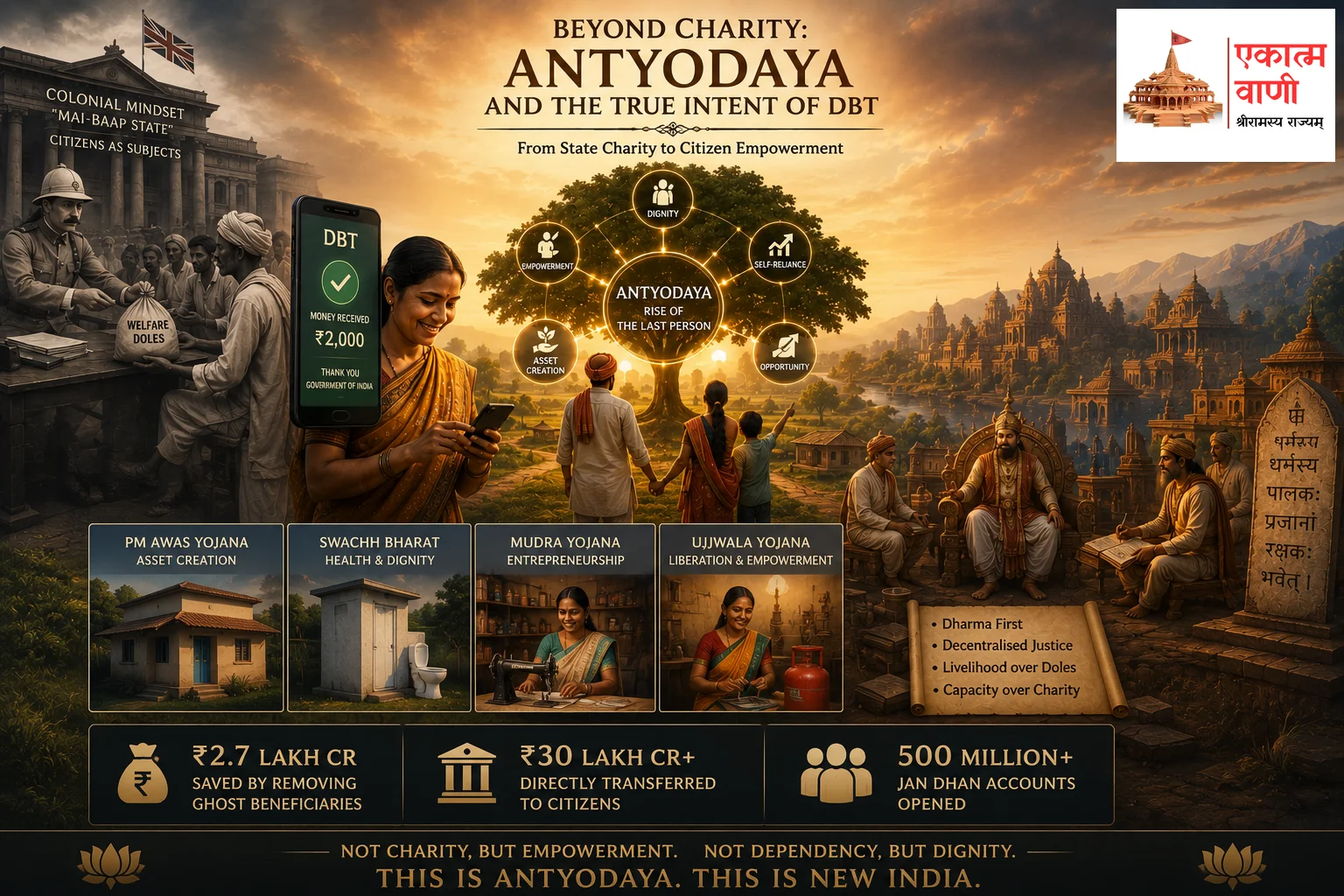
The genesis of Direct Benefit Transfer was rooted in a pragmatic necessity: to plug the leaking bucket of public distribution. For decades, the Indian state operated on a leaky pipeline where a rupee sent from Delhi turned into mere paise by the time it reached the village. DBT was introduced to bypass the corrupt middleman, ensuring that subsidies for gas, rations, and housing reached the intended bank accounts directly. On paper, the objective is noble—fiscal discipline and targeted delivery. It aims to provide a cushion for the vulnerable, ensuring basic dignity in a rapidly changing economy. However, the scope of these schemes must be scrutinised beyond mere accounting. The fundamental purpose of any state intervention should be to render itself unnecessary over time by empowering the citizen. Yet, as we look at the burgeoning numbers of beneficiaries and the political clamour for competitive populism, we are compelled to ask the uncomfortable question: Is the true purpose of spiritual and material upliftment actually being fulfilled, or are we merely managing poverty?
The Colonial Hangover in Policy Design
If the purpose is not fully met, the fault lines lie in the very architecture of our governance, which remains heavily influenced by a colonial mindset. The modern Indian state, despite seven decades of independence, often functions on the western premise that the State is the 'Leviathan'—the omnipotent provider—while the citizen is a helpless subject in need of rescue. This is a direct inheritance from our colonial masters, who viewed the administration as the Mai-Baap (supreme guardian) and the people as 'subjects' incapable of self-rule.
Western welfarism is transactional; it views the poor as a statistic to be managed. When policies are designed with this mindset, they foster a culture of dependency rather than agency. We see this in schemes that prioritise free consumption over asset creation. By treating the citizen as a mere receptacle for state largesse, we inadvertently strip them of their dignity and enterprise. The state assumes the role of a benevolent feudal lord, dispensing favours, rather than a facilitator of potential. This approach contradicts the very soil of India, which values self-respect (Swabhiman) above all.
Evolution of Governance
The "Mai-Baap" State. Citizens as helpless subjects.
The Leaky Pipeline. Welfare as charity/doles.
DBT as empowerment. Citizens as Trustees.
Governance in Ancient India: The King as Trustee
To find the remedy, we need not look to the London School of Economics, but to our own civilisational wisdom. In Ancient India, the relationship between the ruler (Raja) and the ruled (Praja) was not one of master and servant, but of a Trustee and the Beneficiary. The King was never the owner of the nation’s wealth; he was merely its custodian.
| Aspect | The Colonial View (Leviathan) | The Dharmic View (Trustee) |
|---|---|---|
| Role of State | Omnipotent Provider (Mai-Baap) | Custodian / Nurturer (Palak) |
| Citizen Status | Helpless Subject | Active Beneficiary (Praja) |
| Goal | Dependency Management | Self-Reliance (Purushartha) |
In the Dharmic tradition, the King was bound by Rajdharma. The Arthashastra and the Mahabharata’s Shanti Parva elucidate that the King’s happiness lies in the happiness of his subjects. However, this did not imply handing out doles. The state’s role was to create an ecosystem—infrastructure, irrigation, security—where the individual could thrive through their own Purushartha (effort). Resources were distributed to facilitate production and livelihood, not to encourage lethargy. For instance, during the Mauryan era, the state actively facilitated trade and agriculture, ensuring that even the forest dwellers had a role in the economy. The King was the Palak (Nurturer), ensuring that the weak were protected from the strong (Matsyanyaya), but the ultimate goal was always self-reliance, not state-dependence.
Moving from Handouts to Asset Creation
Where DBT aligns with this Bharatiya ethos, it succeeds brilliantly. We must distinguish between 'welfare as charity' and 'welfare as empowerment'. Schemes that use DBT to create tangible assets are the modern equivalent of the Dharmic model.
- PM Awas Yojana: Asset creation (Housing) that restores dignity.
- Swachh Bharat: Sanitation infrastructure for health and safety.
- Mudra Yojana: Capital for small entrepreneurs (Trusting enterprise).
- Ujjwala Yojana: Liberation from drudgery for productive work.
These initiatives mirror the ancient intent: providing the tools for the individual to stand on their own feet. When a woman receives a gas connection (Ujjwala), she is not just receiving a subsidy; she is being liberated from the drudgery of smoke, freeing her time for productive work. This is the Right Manner of execution—where the transfer of wealth leads to a transformation of life.
The Welfare Shift Strategy
The Lens of Integral Humanism
The philosophical bedrock for this critique is Ekatma Manav Darshan, propounded by Pandit Deendayal Upadhyaya. He argued vehemently against the Western binaries of Capitalism (which idolises the market) and Socialism (which idolises the State). Upadhyaya ji posited that society is an organic whole, and the individual is not in conflict with the state but is an integral part of it.
Defining Antyodaya
"Antyodaya is not about pitying the poor. It is about recognising that the nation’s soul (Chiti) is hurt when its weakest member suffers."
Goal: Restoration of capacity, not mechanical transfer of funds.
According to this philosophy, Antyodaya is not about pitying the poor. It is about recognising that the nation’s soul (Chiti) is hurt when its weakest member suffers. Therefore, economic assistance must not be a mechanical transfer of funds but a restoration of the individual’s capacity to contribute to the whole. Deendayal ji warned against "Statism" where the government swallows the community’s initiative. A true Bharatiya welfare state must ensure that DBT schemes do not atomise society into selfish individuals chasing freebies, but rather nurture a sense of community and shared destiny. The aid must be temporary, targeted, and transformative.
Visualising the Impact: Data for Consideration
To objectively assess the shift from 'leakage' to 'delivery', one must look at the figures. These inputs can be visualised to understand the scale of the transition:
- Leakage Prevention: Since its inception, DBT has reportedly saved the exchequer over ₹2.7 lakh crore(approx) by removing ghost beneficiaries.
- Scale of Transfer: Over ₹30 lakh crore has been transferred directly to bank accounts, bypassing the bureaucratic mesh.
- Financial Inclusion: The opening of over 500 million Jan Dhan accounts serves as the digital infrastructure for this modern Antyodaya.
Fiscal Impact Analysis (in Lakh Crore ₹)
Conclusion
In conclusion, the debate over Direct Benefit Transfer is not merely economic; it is civilisational. If we treat DBT as a permanent crutch, we are merely perpetuating a colonial, feudal relationship between the state and the citizen. However, if we view it through the lens of Antyodaya and Integral Humanism, DBT transforms into a powerful instrument of justice. The state must remain steadfast in its role as a Palak—a guardian that waters the roots so the tree may grow, rather than a master who rations the fruit. We must reject the Western seduction of the "nanny state" and embrace the Bharatiya ideal of the "enabling state," where the ultimate metric of success is not how many people receive aid, but how many no longer need it.
Keywords
Direct Benefit Transfer, Antyodaya, Ekatma Manav Darshan, Welfare State, Deendayal Upadhyaya, Colonial Mindset, Indian Economy, Dharmic Governance, PM Awas Yojana, Mudra Yojana, Financial Inclusion, Social Empowerment.
 Continue With Google
Comments (0)