

The Mirage of Mega-Structures: A Crisis of Perspective
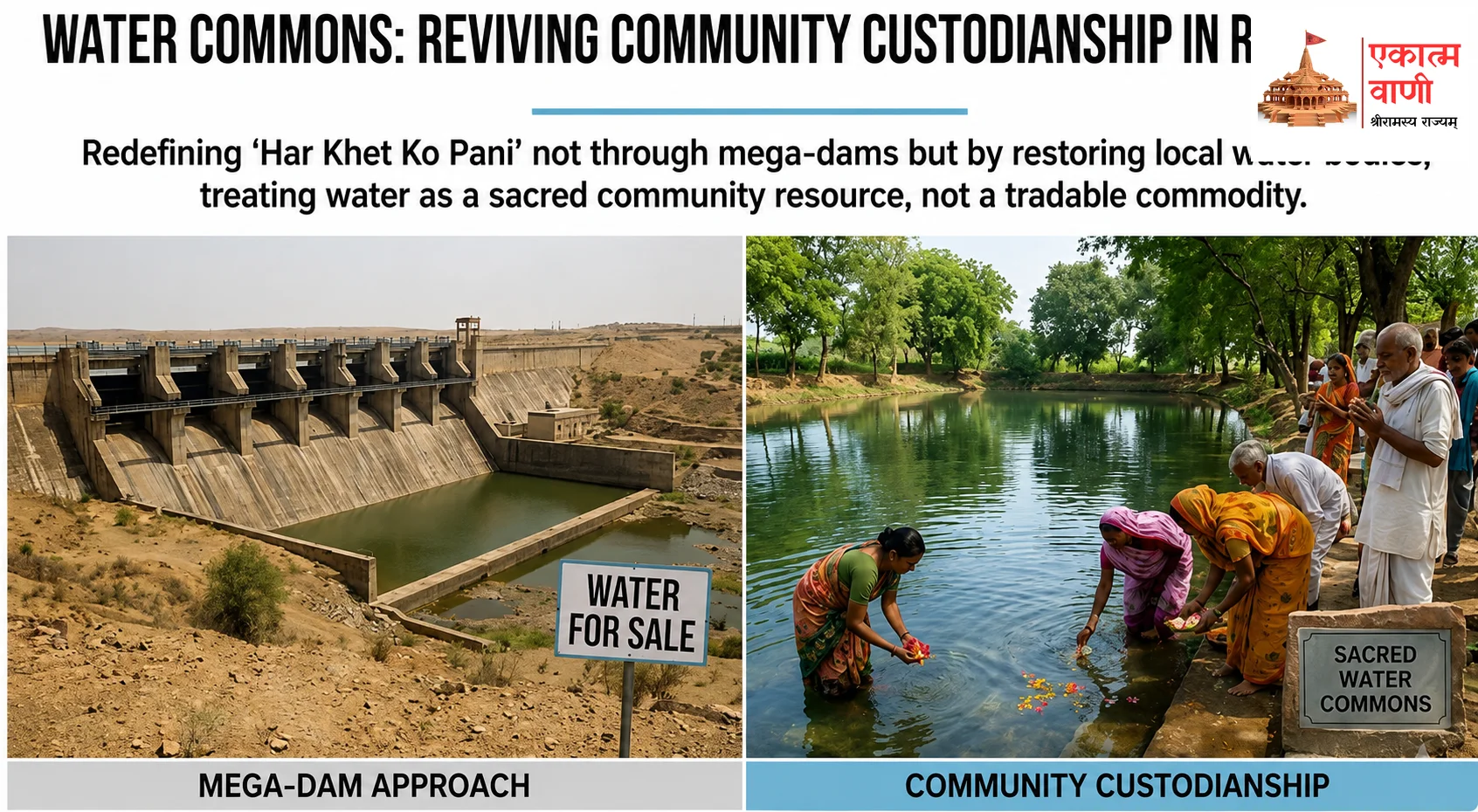
The slogan 'Har Khet Ko Pani' (Water for Every Field) is a noble aspiration, critical for the survival of our agrarian nation. However, in modern policy discourse, this phrase has become synonymous with colossal engineering projects—massive dams, interlinked rivers, and sprawling concrete canals. The fundamental premise of this article is to challenge this centralised, capital-intensive approach. True water security lies not in conquering rivers but in the localised, decentralised management of water resources—ponds, wells, and check dams.
Water, in its essence, is a common pool resource, vital for the sustenance of the entire ecosystem, not just a raw material for industrial agriculture. Yet, as we survey the parched landscapes of Marathwada and Bundelkhand, despite decades of dam construction, we must face a harsh truth. The grand promises of the "Temples of Modern India" (as Nehru called dams) have often left the small farmer high and dry, displacing millions and disrupting ecological flows. We must ask the pertinent question: Has the obsession with mega-structures truly quenched the thirst of the Indian soil, or has it merely privatised a public good, leaving the common man with empty hands and dry wells?
"Has the obsession with mega-structures truly quenched the thirst of the Indian soil, or has it merely privatised a public good?"
The Western Commodification: Why We Are Thirsty
The failure to achieve universal water security is rooted in a philosophical deviation. We adopted a Western, utilitarian worldview that sees water as a "commodity"—a product to be bottled, priced, and sold. This perspective is alien to the Indian ethos. The core reason for our current water crisis is the systematic dismantling of community ownership in favour of state and corporate control.
Our policy and executional strategies have been heavily influenced by colonial engineering and World Bank prescriptions, which prioritise supply-side management (building more infrastructure) over demand-side management (conservation and efficiency). This "hydraulic mission" ignores the diverse geography of Bharat. We applied a "one-size-fits-all" solution, ignoring that the water ecology of the Thar Desert is vastly different from the Gangetic plains. By vesting the ownership of water bodies in the state rather than the local Samaj (community), we absolved the villagers of their responsibility. When the government owns the pond, the villager stops cleaning it. This alienation of the people from their natural resources is the tragedy of the modern Indian water sector.
The Wisdom of Jal-Sanskriti: Ancient Indian Water Management
To understand true sustainability, we must turn to Ancient India, where water management was a refined art and a spiritual duty. Our ancestors understood that water is Jeevana (life itself), not just H2O. The text Kashyapa Krishisukta describes detailed methods of reservoir construction and maintenance, emphasising that water bodies must be managed by the local community.
The Cholas in the south built an intricate system of Eris (tanks) that were interconnected; when one filled, it overflowed into the next, ensuring no wastage. In the arid regions of Rajasthan, the Johads, Baoris (stepwells), and Tankas were marvels of engineering designed to capture every drop of rain. These were not built by the King’s PWD; they were built and maintained by the villagers through Shramdaan (voluntary labour). The intricate Ahar-Pynes of Bihar were indigenous floodwater harvesting systems that turned the curse of floods into the blessing of irrigation. In this system, water was a Deity (Varuna), and polluting or wasting it was a sin. The community decided how much water each farmer would get, ensuring equity based on need, not greed.
| Parameter | The Big Dam Model | The Community Pond Model |
|---|---|---|
| Cost | High (Capital Intensive) | Low (Local Labour/Shramdaan) |
| Displacement | Displaces millions | Zero displacement |
| Ecology | Submerges forests, emits methane | Enhances biodiversity, sequesters carbon |
| Equity | Head-end farmers benefit most | Equitable distribution via community |
Table 1: Comparative analysis of centralized vs. decentralized models.
Modern Custodians: Restoring the Balance
Where we have returned to these roots, the results have been miraculous. There are shining examples where the rejection of the "commodity" view in favour of the "commons" view has transformed landscapes.
Tarun Bharat Sangh (Rajasthan)
Led by Rajendra Singh, villagers revived thousands of traditional Johads. This stopped desertification, revived the Arvari river, and formed a "River Parliament" to govern usage.
Hiware Bazar (Maharashtra)
Transformed from drought-prone to a millionaire’s village. They banned water-guzzling crops and treated groundwater as a community resource, prohibiting private deep borewells.
Ekatma Manav Darshan: Water as a Bond of Unity
The shift towards community ownership is deeply aligned with Ekatma Manav Darshan (Integral Humanism). Pt. Deendayal Upadhyaya emphasised the concept of Chiti (national soul), suggesting that our development models must resonate with our cultural DNA.
Integral Humanism posits that there is an organic unity between the individual, society, and nature. Water is the blood that flows through this organic whole. Treating water as private property creates conflict and fragmentation (Sangharsh). Treating it as a Common Resource fosters cooperation and integration (Samanvay).
Deendayal ji warned against the over-centralisation of power. A centralised water grid disempowers the village. In contrast, decentralised water harvesting embodies the principle of Gram Swaraj. When a community builds a check dam together, they are not just conserving water; they are cementing social cohesion. They are practising Dharma—the duty to sustain life. This is the only way to ensure Antyodaya, ensuring the last person in the queue gets water, rather than it being hogged by the powerful head-end farmers.
The Hydraulics of Hope: Data and Reality
The economic and ecological case for community water management is supported by compelling data.
2-5m
Groundwater Level Rise
Achieved within 2 years via check dams.
46,000
Tanks Restored
Under Mission Kakatiya (Telangana).
60%+
Irrigation Coverage
Provided by minor irrigation schemes (wells/tanks).
Conclusion: From State Control to Community Care
In conclusion, 'Har Khet Ko Pani' will remain a hollow slogan if we continue to rely on the concrete leviathans of the West. The solution to India’s water crisis does not lie in more money or more concrete, but in more community. We must shift our gaze from the river basin to the village watershed.
We must dismantle the colonial legacy that treats water as a state subject and reinstate the ancient truth that water is a community asset. By reviving our Talabs, Kunds, and Johads, we do not just save water; we save the very soul of rural Bharat. It is time to move from "Water for Profit" to "Water for Life." Let the village be the manager, the custodian, and the beneficiary of its own water. This is the path of resilience; this is the path of the Rishi.


 Continue With Google
Comments (0)