


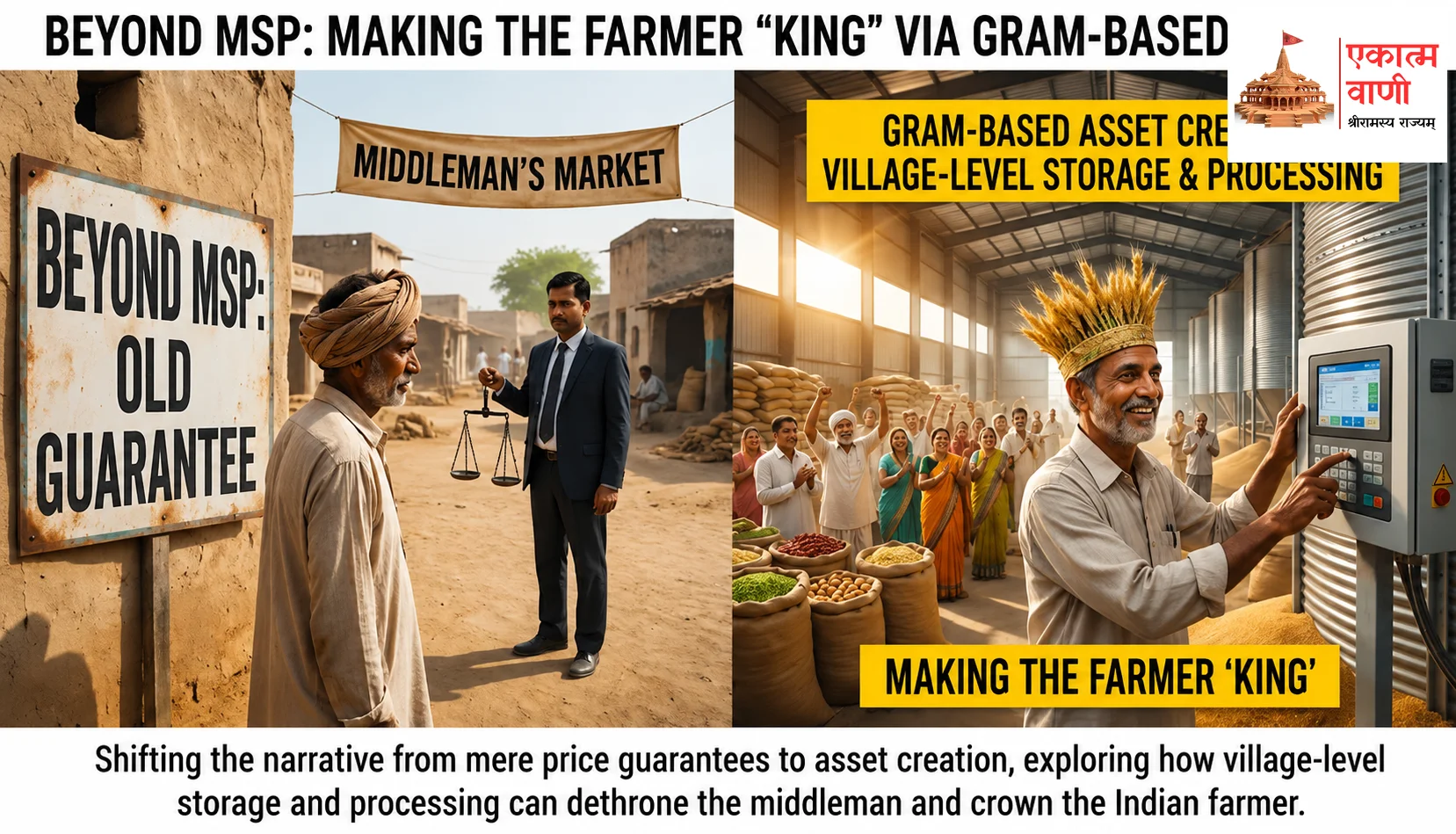
The Mirage of MSP: A Band-Aid for a Deep Wound
For decades, the discourse surrounding Indian agriculture has been monomaniacally focused on three letters: MSP (Minimum Support Price). It is often touted as the panacea for all agrarian distress, a magic wand that, if waved correctly by the state, will ensure prosperity for the Annadata. The purpose of MSP was originally to provide a safety net, a floor price to protect farmers from the volatility of the market. However, the current agitation and the relentless demand for legalising MSP overlook a fundamental economic reality.
"Price is a function of power, and power comes from holding capacity."
The purpose of agricultural commerce is to ensure the farmer receives the true value of his toil. Yet, today, the farmer is forced to sell his produce immediately after harvest—a period known as the "glut season"—when prices are naturally at their lowest. He sells because he lacks the infrastructure to hold his stock. He sells because he needs immediate liquidity. The MSP system, while necessary as a temporary shield, has morphed into a crutch that perpetuates dependency on the state rather than fostering market independence. We must ask the uncomfortable question: Has the relentless focus on MSP truly empowered the farmer to dictate terms to the market, or has it merely reduced him to a permanent petitioner at the gates of government procurement centres?
The Centralised Trap: A Western Legacy
The core reason the farmer remains vulnerable is not the absence of a law, but the absence of logistical sovereignty. The failure to empower the farmer lies in our adherence to a Western-influenced, centralised model of food management. We have adopted an industrial approach where food is harvested in the village, transported hundreds of kilometres to urban mandis or massive Food Corporation of India (FCI) godowns, processed in industrial hubs, and then shipped back to rural areas for consumption.
Village Harvest
Production PointUrban Mandi / FCI
High Food MilesRural Consumer
Return JourneyThis logistical absurdity is a colonial hangover. It is driven by the Western obsession with "economies of scale," a concept that often fails in the fragmented, diverse landscape of Bharat. This centralised strategy strips the village of its economic autonomy. By pushing the farmer to sell raw produce immediately, the current system transfers the value-addition capability—and thus the profit—from the village to the urban industrialist. The farmer sells wheat at ₹20/kg, and the urban consumer buys flour at ₹40/kg. The difference is pocketed by the middleman, the transporter, and the processor. Our policy execution has been lazy; instead of building infrastructure at the Gram (village) level, we built it at the city level, assuming that urbanisation is the only path to modernisation. This neglect of rural infrastructure is why the farmer is a price-taker, not a price-maker.
The Wisdom of the Ancients: Decentralised Resilience
To find the solution, we need not look to the Chicago School of Economics but to the Arthashastra and our own civilisational history. In Ancient India, the economy was structured around the principle of Gram Swaraj (Village Self-Rule), not just politically, but economically. The village was a self-sustaining unit.
Historical records and texts mention the existence of community granaries known as Kosh. These were not massive, centralised warehouses located in the capital, but decentralised storage units present in every cluster of villages. The local administration ensured that a portion of the harvest was stored locally to buffer against famine and price fluctuations. Processing was also local. The oil press (Ghani), the flour mill, and the jaggery unit were all village-based industries.
By processing produce locally, the ancient village retained the biomass (husks, oil cakes) for cattle feed and manure, closing the ecological loop. The farmer did not just sell raw material; he participated in the value chain. This decentralised model ensured that wealth circulated within the rural ecosystem rather than being siphoned off to the metropolis. The ancient Indian farmer was not desperate to sell; he had the holding power, and thus, the bargaining power.
Modern Avatars of Gram-Swaraj: Doing It Right
While the mainstream narrative is stuck on MSP, there are quiet revolutions happening where this ancient wisdom is being reapplied with modern technology. We see successful examples where Gram-Based Storage and Processing have transformed lives.
Sahyadri Farms (Maharashtra)
Farmers established local collection centres. By converting grapes into raisins or juice at the source, they insulated themselves from fresh fruit market volatility.
Bihar Maize Model
Small-scale silos allow farmers to store maize. Instead of selling at throwaway prices during harvest, they wait for the lean season for a premium.
Erode Turmeric (Tamil Nadu)
Shifted from selling raw turmeric to village-level polishing units. Farmers bypassed the first layer of traders, effectively doubling their margins.
The "Holding Power" Premium (Maize)
Visualizing the 30% additional revenue gained by holding maize stocks until the lean season.
These examples prove that when the infrastructure for primary processing (grading, sorting, drying) and storage is brought to the farm gate, the farmer transforms from a raw material supplier into an agribusiness entrepreneur. He stops begging for a price and starts commanding one.
Ekatma Manav Darshan: Economic Democracy
This shift from centralised procurement to village-level management is the practical manifestation of Ekatma Manav Darshan (Integral Humanism). Pt. Deendayal Upadhyaya was a staunch critic of the blind imitation of Western industrialisation which leads to the concentration of wealth. He advocated for Vikendrikaran (Decentralization). According to Integral Humanism, the economic system should be designed such that the means of production and the storage of wealth are distributed as widely as possible. A system where the farmer depends on the government for MSP is a system of "State Capitalism," not true freedom.
Deendayal ji envisioned an economy where the "Man" is at the centre. If the farmer has to travel 50 kilometres to store his grain, the system is anti-human. If the storage is in his village, the system serves the human. By establishing Gramin Bhandaran (Village Storage), we align with the principle of Antyodaya—empowering the last man in the line. It restores the dignity of the village, turning it from a labour colony for cities into a hub of economic activity. This is the path to a truly Atmanirbhar Bharat.
The Arithmetic of Autonomy: Data and Logistics
The economic argument for decentralised storage is backed by compelling data. The losses incurred due to poor infrastructure are staggering, and the potential for gain through simple value addition is immense.
₹92,000 Crore
Annual post-harvest losses in India due to poor storage and logistics.
Value Addition Potential (₹ per Kg)
Comparison of prices for raw produce vs. simple processed goods (Tomato and Wheat).
Price Appreciation Over Time
Commodity prices typically rise by 25% within 4 months of harvest, offering profit without subsidy.
Processing Cost is minimal if done via community solar-powered mills. Furthermore, decentralised storage reduces the "Food Miles"—the distance food travels. This lowers transportation costs and carbon emissions, making it an environmentally superior model.
Conclusion: From Petitioner to Sovereign
In conclusion, the clamour for MSP, while understandable in the current distress, is a shortsighted goal. It seeks to fix the symptoms of a rigged market without curing the disease of logistical helplessness. The true liberation of the Indian farmer lies not in a government guarantee, but in the restoration of his capacity to hold and process his own produce.
| Aspect | The MSP Trap (Current) | The Storage Freedom (Proposed) |
|---|---|---|
| Timing | Sell immediately at Harvest (Glut) | Sell during Lean Season (Demand) |
| Price Mechanism | Government fixes floor price | Market forces + 25% Premium |
| Role of Farmer | Petitioner / Raw Supplier | Price Maker / Entrepreneur |
| Infrastructure | Centralized (City based) | Decentralized (Village based) |
We must pivot our national strategy towards Gram-Based Storage and Processing. We need a grid of micro-warehouses and micro-processing units in every Panchayat. When the farmer can store his grain in his own village and sell finished goods instead of raw material, he ceases to be a victim of market forces. He becomes the market. This is the Bharatiya way—resilient, decentralised, and dignified. It is time to stop asking for the right price and start building the right infrastructure.
 Continue With Google
Comments (0)