


The Soul of the Soil: A Civilisational Crisis
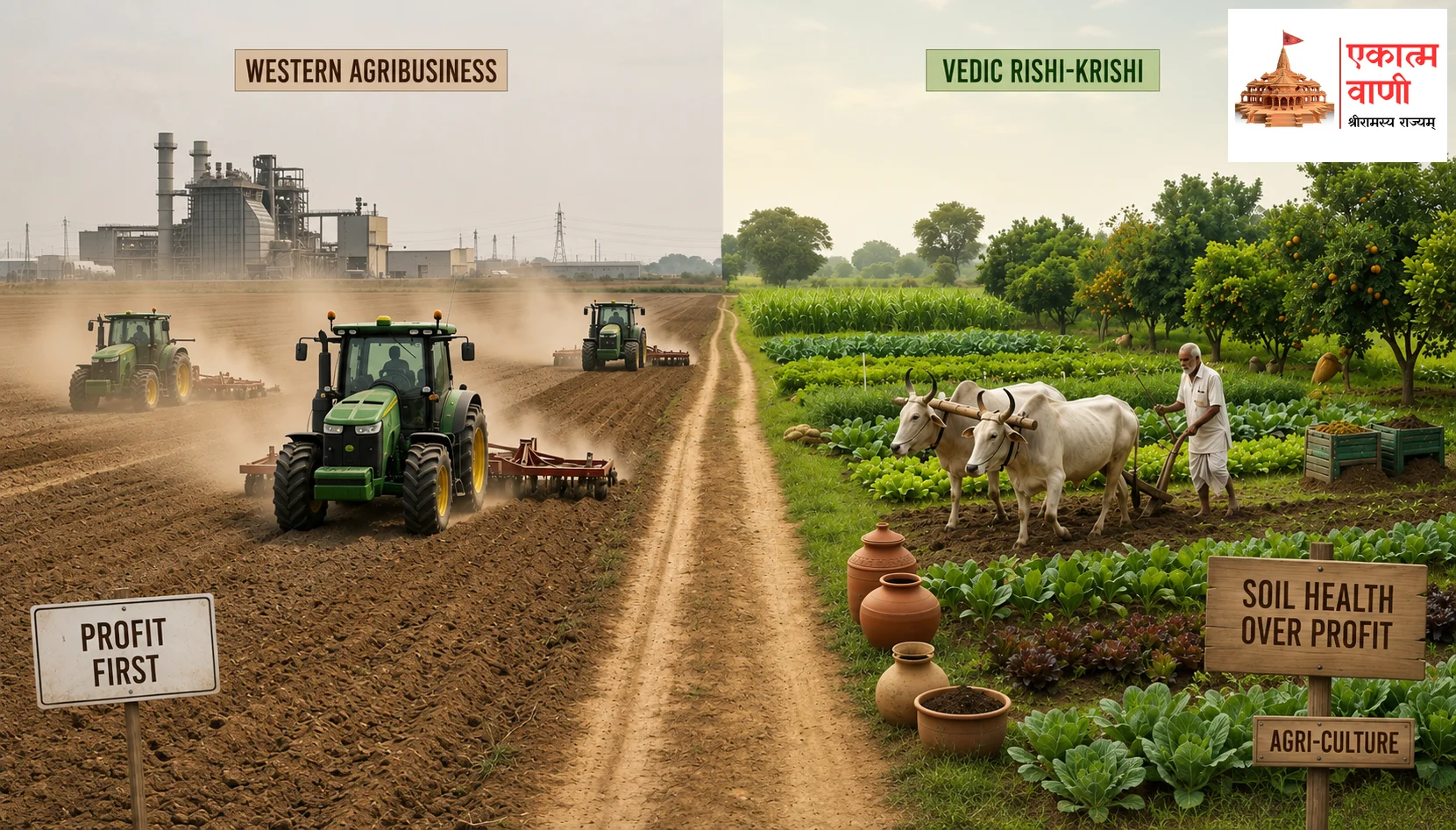
For millennia, agriculture in Bharat was not merely a means of production; it was a culture, a way of life, and a spiritual duty. We termed it Krishi, a word that resonates with the rigour of the Rishi (sage). However, in the post-independence era, swayed by the dazzling but hollow promises of the West, we allowed our sacred relationship with the land to be commodified. We transitioned from Agri-Culture—a symbiotic relationship with Mother Earth—to Agribusiness, a sterile, profit-driven industrial model.
Today, as we stand at the crossroads of an ecological emergency and an agrarian crisis, we must ask ourselves: Is the fundamental purpose of agriculture being met? The primary objective of farming is to nourish the population while sustaining the natural resource base for future generations. It is to maintain the Sanatan balance between human need and nature’s bounty. Yet, looking at the barren fields of Punjab, the debt-ridden farmers of Vidarbha, and the toxicity on our plates, one is compelled to ask the uncomfortable question: Has the modern industrialisation of our farms truly fulfilled its purpose, or has it severed the very artery of our civilisation?
Global GDP Contribution of Ancient India
Of India's Land Undergoing Desertification
Drop in Groundwater Levels in 20 Years
The Western Blight: Why We Lost Our Way
The failure to sustain a healthy agrarian ecosystem is not an accident; it is the direct consequence of adopting a Western worldview that is fundamentally alien to the Indian ethos. The core reason for our current agrarian distress lies in the blind imitation of the "Industrial Farming" model. This approach treats the land not as a living entity, Bhumi Mata, but as a factory floor—an inert resource to be exploited for maximum output.
The policy and executional strategies opted for in the past few decades were heavily influenced by a colonial mindset that views nature as a force to be conquered rather than revered. The so-called Green Revolution, while perhaps well-intentioned to solve immediate hunger, introduced a chemical dependency that enslaved our farmers to multinational corporations. We replaced our indigenous seeds, which were resilient and acclimatised to our geography, with laboratory-created hybrids requiring endless inputs of fertilisers and pesticides. This was not progress; it was a philosophical regression. We prioritised the GDP over the GNP (Gross Natural Product), ignoring the fact that in the Indian context, economics cannot be divorced from ethics (Dharma). The West chases short-term yield; Bharat has always sought eternal sustainability.
Figure 1: Current status of land degradation in India due to intensive farming practices.
The Vedic Wisdom: How It Was Done in Ancient India
To understand the solution, we must look back to when Bharat was the agricultural powerhouse of the world, commanding over a quarter of the global GDP. In ancient India, farming was governed by the principles of Rishi-Krishi. This was not primitive farming; it was highly scientific, observation-based, and spiritually grounded.
Our texts, such as the Krishi-Parashara and the Vrikshayurveda, detail complex systems of crop rotation, soil nourishment, and water management that modern science is only now beginning to comprehend. The ancient Indian farmer understood the concept of the "Soil Food Web" long before Western biologists coined the term. They knew that the soil was alive, teeming with Jiva (microbes), and that the destruction of these microbes was a sin.
The Methodology of Milking, Not Bleeding
The method was clear: Milking the Earth, not bleeding Her. The use of Panchagavya (a blend of five cow products) and Jeevamrut ensured that the soil remained nutrient-rich without external chemicals. The plough was designed to till only the topsoil, preserving the structure of the earth below. Trees were planted along field bunds to maintain a micro-climate, a practice the West now repackages as "Agroforestry." In the Vedic tradition, agriculture was an act of Yajna (sacrifice), where the farmer offered his labour to the land, and the land, in turn, blessed him with abundance.
Beacons of Hope: Returning to Roots
While the mainstream narrative remains obsessed with chemical farming, there are shining examples where the return to traditional wisdom has yielded miraculous results. Consider the natural farming movement sweeping across states like Andhra Pradesh and Gujarat. Here, farmers have rejected the toxicity of urea and diammonium phosphate (DAP) in favour of Subhash Palekar Natural Farming (SPNF), which is essentially a repackaging of our ancient wisdom.
We see this success in the tribal belts of Madhya Pradesh, where traditional grains like Kodo and Kutki—once dismissed by the elitist Western diet—are making a resurgence. These crops are drought-resistant, require zero chemicals, and are nutritionally superior to the genetically modified wheat forced upon us. Another prime example is the Sikkim model, which declared itself the world’s first organic state. They did not succumb to the pressure of industrial lobbyists. Instead, they proved that by respecting the laws of nature, one could achieve food security without compromising the ecological sanctity of the Himalayas. These examples are not anomalies; they are proof that the Bharatiya way is the only sustainable way.
| Feature | Industrial Agribusiness | Rishi-Krishi (Vedic) |
|---|---|---|
| View of Soil | Inert factory floor | Living entity (Bhumi Mata) |
| Inputs | Chemical Fertilizers/Pesticides | Jeevamrut, Panchagavya |
| Economics | High input, High debt | Zero input, Sustainable profit |
Table 1: Divergence between Western Industrial models and Indian Vedic traditions.
Ekatma Manav Darshan: Soil Health is Integral Humanism
The transition from chemical farming to organic or natural farming is not just an agronomic shift; it is the practical application of Ekatma Manav Darshan (Integral Humanism), propounded by Pt. Deendayal Upadhyaya. This philosophy argues that human life cannot be viewed in isolation; it is integrated with the community, nature, and the cosmos.
"Industrial farming is based on a fragmented view of the world—what Deendayal ji called 'Khandit' vision—where profit is separated from morality, and production is separated from pollution."
- The Philosophy of Integration
In contrast, Integral Humanism teaches us that the health of the soil determines the health of the plant, which determines the health of the human, which in turn determines the health of the nation. When we poison the soil to increase yield, we violate the principle of Advaita (non-duality); we harm ourselves by harming the earth. A true adherent of Ekatma Manav Darshan understands that Artha (wealth) must be pursued within the boundaries of Dharma. Therefore, placing soil health above profit is the highest form of patriotism. It is an acknowledgment that the land is not just real estate, but the physical manifestation of Bharat Mata. To poison her for profit is an act of treason against our cultural heritage.
The Data Speaks: The Cost of Deviation
If philosophy does not convince the modern sceptic, let the data speak. The blind pursuit of Western industrial agriculture has led us to a precipice.
Soil Degradation: According to recent government reports, nearly 30% of India’s land is undergoing desertification. The organic carbon content in our soil, which should ideally be above 1%, has plummeted to below 0.3% in intensive farming belts like Punjab and Haryana.
Health Crisis: The infamous "Cancer Train" from Bathinda to Bikaner is a harrowing testament to chemical farming. Studies indicate a direct correlation between the excessive use of pesticides and rising cancer rates in rural India.
Figure 2: Drastic decline in Soil Organic Carbon content in intensive farming belts.
Economic Viability: While industrial farming promises higher yields, the input costs (seeds, fertilisers, pesticides) have skyrocketed. Data suggests that the Net Income of farmers practising natural farming is often higher than conventional farmers because their input costs are near zero, even if the initial yield volume is slightly lower.
Water Table: The water-guzzling crops promoted by the Green Revolution have depleted our aquifers. In many districts, the groundwater level has dropped by over 60% in the last two decades.
Figure 3: Groundwater depletion trajectory over the last two decades.
Conclusion: The Return to Dharma
In conclusion, the shift from Agribusiness to Agri-Culture is not merely a change in technique; it is a reclaiming of our civilisational identity. We must reject the Western paradigm that measures success solely by the tonnage of grain produced, ignoring the destruction left in its wake. The true measure of our agricultural success is the vitality of our soil and the health of our citizens.
Bharat has the potential to become the Vishwaguru (World Teacher) in sustainable agriculture, guiding a world tired of ecological destruction back to sanity. But to do this, we must have the courage to trust our own ancestors over foreign consultants. We must revive the Rishi-Krishi tradition, understanding that true prosperity—Shubh Labh—arises only when we place the sanctity of the soil above the greed for profit. This is the essence of true nationalism; this is the path of Ekatma Manav Darshan.
 Continue With Google
Comments (0)