
The Sacred Bovine: Beyond the Dairy Ledger
In the collective consciousness of Bharat, the cow (Gau Mata) has never been merely a dairy machine. For thousands of years, the bovine population formed the backbone of our rural economy, the Gram Swaraj. However, modern economic discourse, tainted by a reductionist Western lens, has narrowed the value of cattle down to a single output: milk. When a cow ceases to lactate, or when a male calf is born, the current industrial model labels them "unproductive" or "stray." This article seeks to dismantle this dangerous fallacy.
The true Cow Economy encompasses far more than the dairy industry; it is the foundation of sustainable agriculture. The purpose of maintaining cattle in the Indian context was holistic—providing draught power for tilling, dung for fuel and fertiliser, and urine for pest control and medicine. Yet, as we witness thousands of cattle abandoned on roads or smuggled for slaughter, we must confront a stark reality. The sanctity of the cow is preached, but is the economic logic that sustains her being practised? Is the true purpose of our bovine wealth being fulfilled, or have we reduced a living deity to a balance sheet liability?
The Western Myopia: Why We Failed Our Cattle
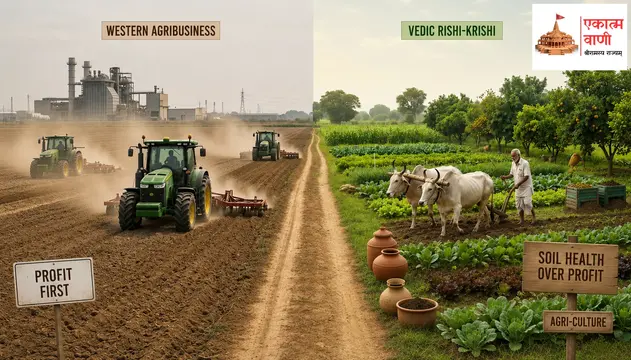
The reason for this tragic disconnect lies in the systemic imposition of a Eurocentric economic model upon an Indic civilisation. The core reason the purpose is not fulfilled is that our policies have been drafted by minds colonised by Western agribusiness theories. In the West, agriculture is industrial, mechanised, and heavily subsidised by the state to support chemical inputs. In that model, an animal is only worth its meat or its milk. When we imported this "utilitarian" mindset, we stripped the cow of her multidimensional role.
| Feature | Industrial Model | Cow Economy (Vedic) |
|---|---|---|
| Value Source | Milk & Meat (Terminal) | Dung, Urine, Labour, Milk |
| Soil Health | Depleted by Chemicals | Enriched by Microbes |
| Non-Milking Cow | Liability / Burden | Asset (Fertilizer Factory) |
Mechanisation replaced the bullock, and chemical fertilisers replaced manure. Policies favoured tractors over bullocks and urea over compost, driven by the lobbying of multinational corporations. We failed to recognise that in the Indian climatic zone, organic carbon in the soil is depleted rapidly by heat, and only the continuous application of cattle manure can sustain fertility. By subsidising chemical fertilisers, the state implicitly made the non-milking cow "expensive" to keep. It is not that the cow became useless; rather, the policy and executional strategy were rigged to make natural farming inputs artificially costlier or less "modern" than their chemical counterparts. We chased a foreign illusion of efficiency and lost our indigenous reality of sustainability.
The Vedic Wisdom: Wealth in Waste
To understand the true economic potential of cattle, one must look at how it was done in Ancient India. In the Vedic period and subsequent eras, the cow was termed Aghanya (not to be killed), not just for religious reasons but for economic survival. The concept of Arthayam (economic management) in ancient texts integrated the cow into every aspect of life.
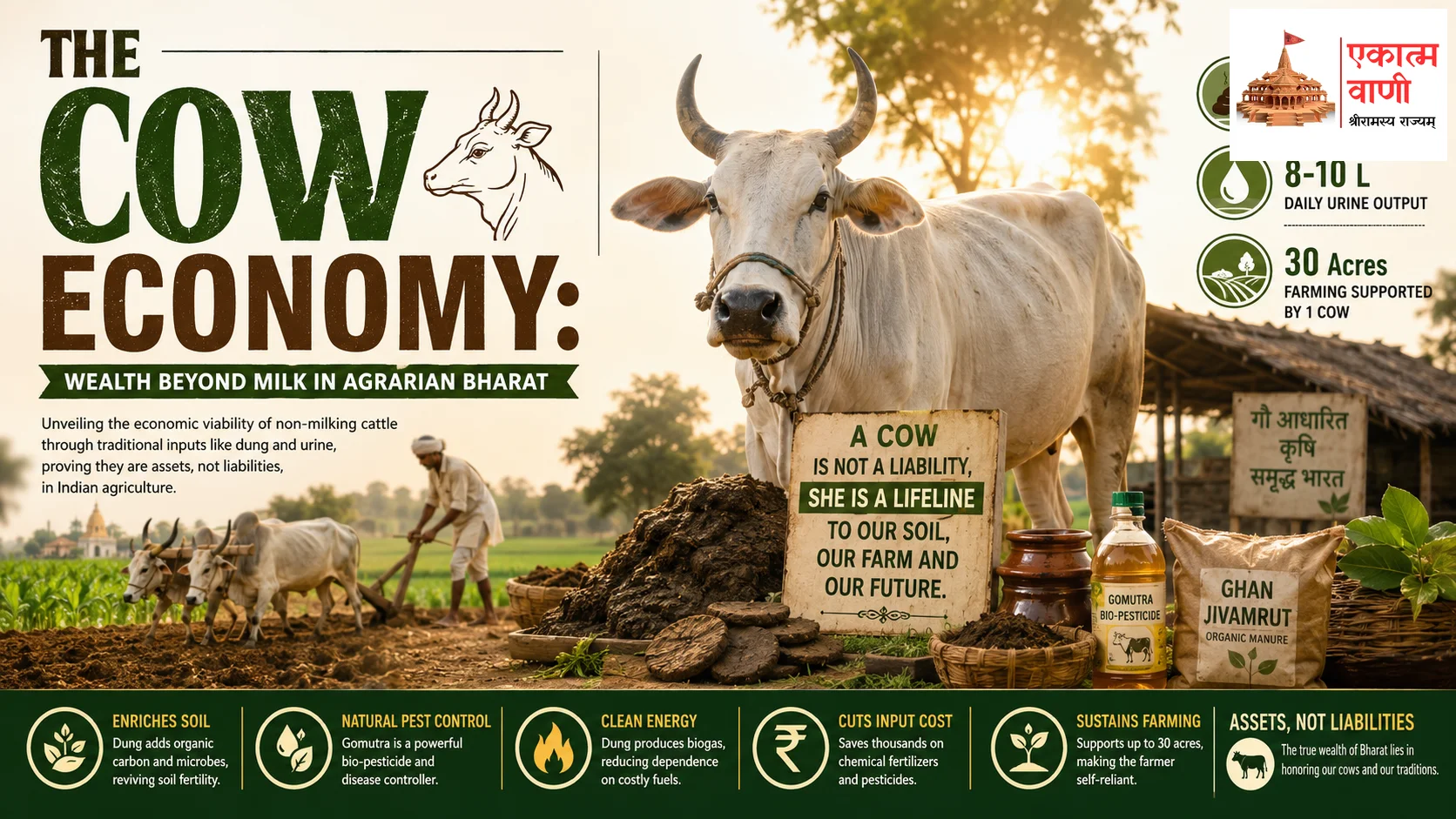
The dung (Gomaya) was known as "Gold" because it enriched the soil with essential microbes. The urine (Gomutra) was a potent bio-pesticide and antifungal agent. Historical records indicate that a single indigenous cow could support the farming of up to 30 acres of land. The male calves were the engines of the nation, ploughing fields and transporting goods. There was zero waste. Even the death of the animal provided leather. The ancient Indian farmer understood that while milk was a seasonal byproduct, dung and urine were daily dividends. They knew that the microbes in the gut of an Indian breed cow (Bos Indicus) were uniquely suited to ferment biomass into rich manure, a scientific fact that modern microbiologists are now validating.
Fig 1. Economic Consistency: Unlike milk which is seasonal, dung and urine provide daily economic value to the farmer.
Modern Success Stories: The Right Path
Despite the onslaught of industrialisation, there remain beacons of hope where this traditional wisdom is applied with remarkable success. Consider the Gaushalas in Rajasthan and Gujarat that have become self-sustainable not by selling milk, but by selling value-added products from non-milking cattle. They produce Ghan Jivamrut (solid manure), bio-gas, phenyl, soap, and incense sticks from cow dung and urine.
These farmers report that one old cow is sufficient to nourish 30 acres of crops. They do not view their non-lactating cattle as burdens; they view them as essential partners in reducing input costs. By eliminating the need for expensive chemical fertilisers (which can cost thousands of rupees per acre), the "unproductive" cow actually saves the farmer significant capital, thereby directly contributing to net profitability. This is the Cow Economy in action—where the absence of milk does not equal the absence of value.
Ekatma Manav Darshan: Integral Economics
This holistic approach is deeply rooted in Ekatma Manav Darshan (Integral Humanism). Pt. Deendayal Upadhyaya argued against the compartmentalisation of life. He posited that an economy that destroys nature to produce wealth is inherently violent and unsustainable. In the context of the cow, Integral Humanism teaches us that an animal's worth is not limited to its immediate consumption value.
From the perspective of Ekatma Manav Darshan, the cow represents the symbiosis between the human (Manav) and the rest of creation (Srishti). Keeping a non-milking cow is not charity; it is an investment in the ecological integrity of the nation. It aligns with the principle of Antyodaya (welfare of the last person), as it empowers the small, marginal farmer to be self-reliant (Atmanirbhar) rather than dependent on chemical corporations. The cow is the centre of a decentralised economic model that respects the cycle of nature. To discard the cow because she is dry is to embrace a materialistic Arth (wealth) devoid of Dharma (duty), a violation of the integral view of life.
The Data of Dung: Assets, Not Liabilities
Let us look at the hard numbers to debunk the myth of the "burden."
- Fertiliser Value: A single indigenous cow produces approximately 10-12 kg of dung and 8-10 litres of urine daily.
- Economic Equivalent: If converted into Jeevamrut or vermicompost, the annual output of dung and urine can replace chemical fertilisers worth ₹50,000 to ₹70,000 per year.
- Cost of Maintenance: The cost of maintaining a non-milking cow is significantly lower, especially in a mixed-farming system where crop residue is used as feed.
- Biogas Potential: The dung from 2-3 cows can generate enough biogas to meet the cooking fuel needs of a rural family, saving approx. ₹10,000 annually.
- Carbon Credits: Future revenue from organic soil sequestration.
Fig 2. Annual Value Generated per Cow. The savings in chemical inputs and fuel far outweigh maintenance costs.
Conclusion: Reviving the Bovine Backbone
In conclusion, the narrative that non-milking cattle are an economic burden is a fabrication of a flawed, industrial worldview. It is a lie sold to us to pave the way for mechanisation and chemical dependency. The Cow Economy proves that when we integrate the bovine into the agricultural cycle—using dung for soil health and urine for pest control—even a dry cow becomes a prolific asset.
For Bharat to regain its agricultural sovereignty, we must stop looking at our cattle through Western glasses. We must recognise that in our Dharmic tradition, economics and ecology were never separate. The cow is the lynchpin of a sustainable future. By valuing the "waste" of the cow as "wealth," we not only save our holy animals but also rescue our farmers from the debt trap of chemical agriculture. It is time to assert that in India, no cow is ever unproductive; it is our modern vision that has become barren.
 Continue With Google
Comments (0)