


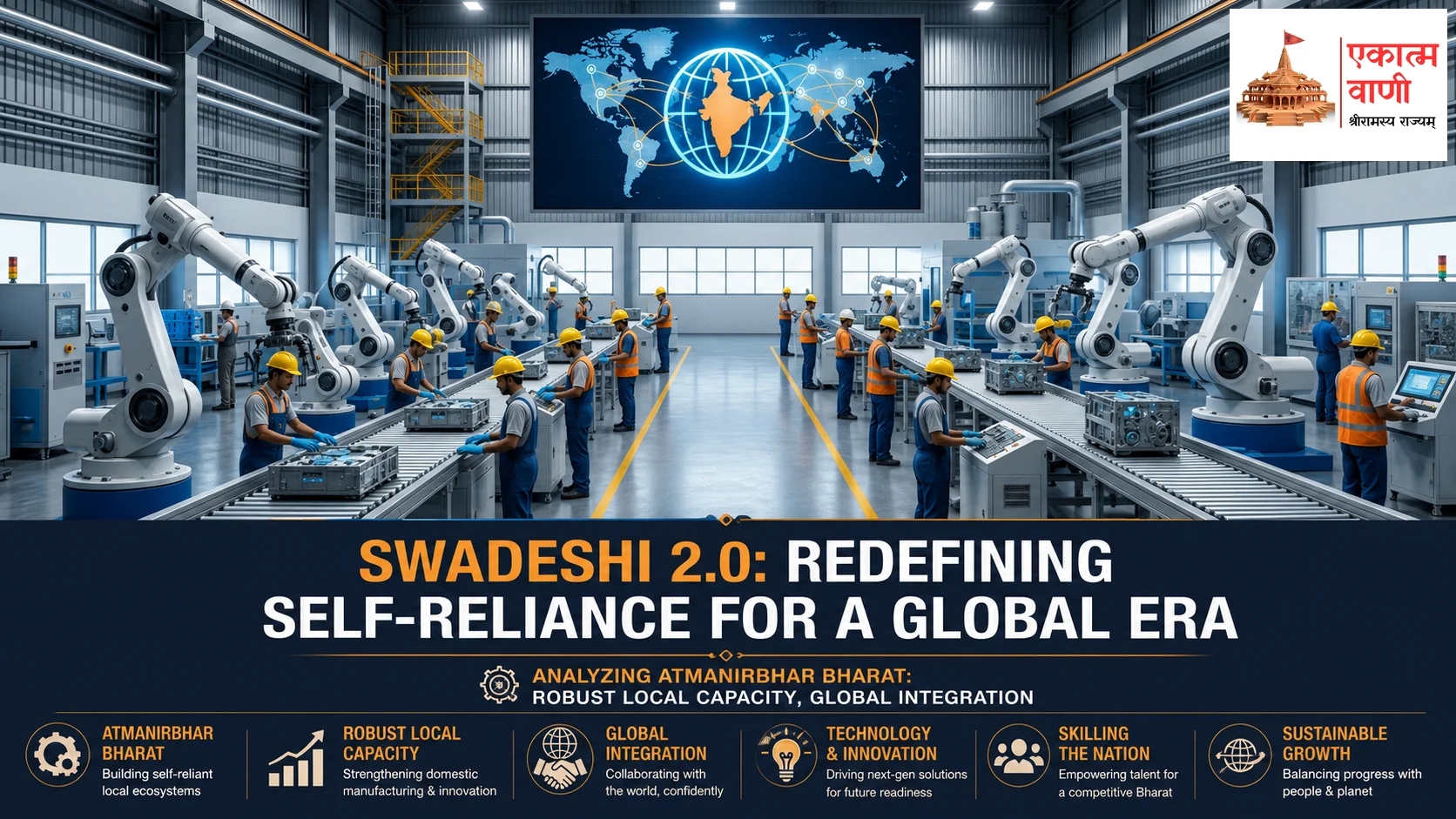
The narrative of the 21st century is being rewritten, and India stands at the very fulcrum of this transformation. For decades, the developing world has swallowed the pill of globalisation prescribed by Western economists—a model that often reduced nations like ours to mere markets or sources of cheap labour. However, the post-pandemic reality has shattered the myth of a borderless, benevolent global village. In this chaotic geopolitical landscape, the concept of Swadeshi has returned, not as a relic of the freedom struggle, but as an urgent economic imperative. This is Swadeshi 2.0. It is not a retreat into isolation; it is a strategic recalibration. It challenges the binary interpretation of 'Atmanirbhar Bharat' as mere protectionism, arguing instead for a civilisational resurgence based on local capacity building. We must ask: Can India reclaim its ancient status as a global manufacturing powerhouse by mimicking the West, or does the answer lie in our own soil?
33%
Ancient India's Share of Global GDP
₹16,000 Cr
Record Defence Exports (FY24)
10x
Growth in Defence Exports (Since 2016)
The Renaissance of Indigenous Manufacturing
The fundamental premise of Swadeshi 2.0 is the realisation that political sovereignty is hollow without economic sovereignty. In the context of the modern global economy, 'Swadeshi' implies a robust, resilient supply chain that originates within the nation's borders but services the world. The 'Atmanirbhar Bharat' (Self-Reliant India) initiative was launched with this very vision: to decouple from unreliable partners (specifically the hegemonic influence of our northern neighbour) and to position India as a trusted node in the Global Value Chain (GVC). The objective was clear—to move beyond the "assembly economy" model, where we merely screw together components imported from abroad, and transition into a "value-creation economy."
This vision encompasses the Production Linked Incentive (PLI) schemes, the push for semi-conductor fabrication, and the aggressive posturing in the defence sector. It is about creating an ecosystem where Indian entrepreneurship can flourish without being suffocated by predatory foreign dumping. The intent is noble and historically necessary. It aims to restore the dignity of Indian manufacturing and the Indian worker. However, as we stand a few years into this mission, we must pause and conduct a ruthless audit of our trajectory. While the slogans are loud and the ambition is soaring, we are compelled to ask a difficult question: Has this purpose truly been fulfilled, or are we mistaking motion for progress?
The Western Shadow on Indian Policy
To answer the question of fulfilment candidly: we have not yet arrived. While there are pockets of brilliance, the wholesale transformation of the Indian supply chain remains elusive. The core reason for this lag is not a lack of talent or capital, but a policy and executional strategy that is still deeply colonised by Western thought processes. We are attempting to build an Indian edifice using a blueprint designed in London and New York.
| Feature | Western Model (Status Quo) | Swadeshi 2.0 (Target) |
|---|---|---|
| Primary Goal | Profit Maximization & Protectionism | Capacity Building & National Resilience |
| Structure | Centralized, Corporate Oligarchies | Decentralized, MSME & Guild-led |
| Governance | Heavy Regulation (Red Tape) | Facilitation & Trust (Dharma) |
| Human Element | Labor as a Cost Unit | Labor as Integral Human Asset |
Table 1: Structural differences between current Western-influenced policies and the intended Swadeshi framework.
The current approach often confuses protectionism (raising tariffs) with capacity building (raising standards and infrastructure). Raising walls against foreign goods is only effective if the domestic alternative is ready to fill the void. Often, our bureaucracy, trained in the Anglo-Saxon model of administration, relies on heavy-handed regulation rather than facilitation. We view industrialisation through the lens of Western mass-production models—centralised, capital-intensive, and profit-maximising—which alienates the vast, decentralised MSME sector that is the backbone of India. We are trying to copy the Chinese model of state capitalism or the Western model of corporate oligarchy, forgetting that India’s strength lies in its diversity and entrepreneurship. By adhering to Western metrics of "Ease of Doing Business" without addressing the "Cost of Doing Business" inherent in our legacy infrastructure, we inadvertently stifle the very Swadeshi spirit we seek to unleash.
The Wisdom of the Ancients: A Blueprint for Prosperity
It is a tragedy of our education system that we look to Adam Smith for economic wisdom while ignoring Chanakya or the economic history of the Chola Empire. There was a time when Bharat commanded nearly a third of the global GDP. This was not achieved through protectionism, but through unmatched excellence.
In ancient India, the economy was structured around Shrenis (guilds). These were not just trade unions but autonomous bodies that set high standards for quality, training, and ethics. From the wootz steel of the south, which forged the Damascus swords, to the muslin of Bengal, India dominated global trade because our products were superior, not because we closed our borders. The supply chain was the community itself. Production was decentralised; the village was a self-sufficient unit of production, yet connected to a global trade network via ports like Lothal and Muziris. The state’s role was limited to ensuring the safety of trade routes and fair taxation—Dharma governed the market, not just the invisible hand. We integrated with the world from a position of strength, exporting value-added finished goods, not just raw materials. This was the original Swadeshi—global engagement driven by local excellence.
Modern Beacons of Self-Reliance
Despite the systemic hurdles, there are sectors where the Swadeshi spirit has broken through the colonial mindset, offering a template for the future. These examples prove that when we apply Indian ingenuity to global problems, we win.
Space Technology (ISRO)
Denied Western tech, ISRO built indigenous cryogenic engines, launching satellites at a fraction of global costs.
Digital Public Infra (UPI)
Bypassed Visa/Mastercard monopolies to build a democratic, interoperable payment system now adopted globally.
Defence Manufacturing
Shifted from largest importer to designer with LCA Tejas and INS Vikrant, securing national architecture.
Vaccine Maitri
Developed Covaxin (Bharat Biotech) instead of waiting for Pfizer, proving bio-pharmaceutical sovereignty.
Ekatma Manav Darshan: The Philosophical Anchor
To truly succeed in Swadeshi 2.0, we must ground our economic policy in Ekatma Manav Darshan (Integral Humanism), as propounded by Pandit Deendayal Upadhyaya. The Western capitalist model views man as a mere economic unit (Homo Economicus), and nature as a resource to be exploited. Marxism views man as a conflict-ridden class entity. Both are alien to the Indian ethos.
"We cannot have islands of prosperity in a sea of poverty. A true Swadeshi supply chain must be decentralised... empowering the artisan in Varanasi and the weaver in Kanchipuram."
Ekatma Manav Darshan argues for an economy that sustains human life and dignity, rather than one that sustains statistical growth alone. It advocates for Antyodaya—the rise of the last person. In the context of supply chains, this means we cannot have "islands of prosperity in a sea of poverty." A true Swadeshi supply chain must be decentralised. It should empower the artisan in Varanasi and the weaver in Kanchipuram, integrating them into the global market through technology, rather than replacing them with automated mega-factories that displace labour. We need an economy that is Swadeshi (indigenous) and Vikendrit (decentralised), ensuring that the fruits of global trade reach the grassroots.
Data Inputs for Visualisation
To understand the trajectory of Swadeshi 2.0, we must look at the data. The following inputs highlight both the strides made and the distance left to cover.
Decline in Toy Imports vs Export Surge (2020-2023)
Figure 1: Impact of Quality Control Orders showing a massive divergence between shrinking imports and rising exports.
Decline in Toy Imports: Since the implementation of Quality Control Orders (a Swadeshi move), toy imports into India dropped by 70% (2020-2023), while exports jumped by 61%.
The Defence Shift: Export Growth (INR Crores)
Figure 2: Exponential growth in defence exports, peaking at ₹16,000 Cr in FY23-24.
The Defence Shift: India's defence exports touched an all-time high of approx ₹16,000 crore in FY 2023-24, a 10x increase since 2016.
Mobile Manufacturing: From Import to Indigenization
2014
2024
Figure 3: A complete reversal in the mobile handset market structure over one decade.
Mobile Manufacturing: From importing 98% of mobile phones in 2014, India now produces 99% of mobile handsets locally.
Dependency Alert: The China Deficit
Despite sectoral wins, the trade deficit with China remains high at approx $85 billion. Critical dependency persists in Pharmaceutical APIs and Electronic components.
Conclusion: The Path Forward
Swadeshi 2.0 is not about closing India’s doors; it is about opening them wide, but only after we have cleaned our own house and strengthened our foundations. We must reject the defeatist notion that Western ideology is the only path to modernity. The "One Earth, One Supply Chain" narrative is failing. The world is looking for a China-plus-one alternative, but India cannot merely be a "plus one." We must be the primary pole of a new, Dharmic economic order.
To integrate with global supply chains effectively, we must stop seeking validation from Western rating agencies and start building systems that work for the Indian reality. We must pivot from protectionism to empowerment—empowering our MSMEs, our innovators, and our traditional sectors with capital, technology, and trust. The time for apologies is over. A self-reliant India is not just a necessity for us; it is a necessity for the world to have a balanced, democratic, and ethical economic future.
 Continue With Google
Comments (0)