
The Mirage of Modern Economics: Is Wealth Truly Welfare?
For decades, the global narrative on national success has been held hostage by a singular, materialistic metric: Gross Domestic Product. We have been conditioned to believe that the relentless accumulation of goods and services, quantified in currency, is the ultimate arbiter of a nation’s standing. However, as we stand at the crossroads of a resurgent Bharat, we must critically examine the foundations of this belief. The fundamental purpose of any economic system, theoretically, is to ensure the well-being, security, and contentment of its populace. It is to create an environment where the human spirit can thrive, anchored by social cohesion and moral fortitude. We are told that rising graphs and swelling foreign reserves are evidence of a "developed" society. Yet, as we witness the glittering skylines of our metropolises rising in tandem with social alienation, we are compelled to ask the uncomfortable question: Is the purpose truly fulfilled?
The Hollow Core of Western Materialism
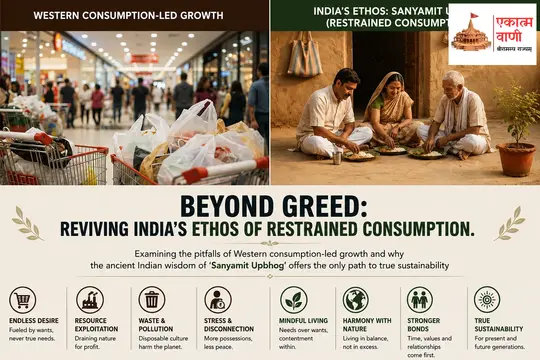
The reason the purpose remains unfulfilled lies in the very DNA of the metric we have adopted. The GDP model is an import from the West—a product of the Industrial Revolution and a worldview that champions hyper-individualism over the collective good. In this westernised paradigm, the human being is reduced to a mere "economic unit" or a "consumer," stripped of their social, spiritual, and familial dimensions. The failure of this model in the Indian context is not merely an error of calculation; it is a clash of civilisations.
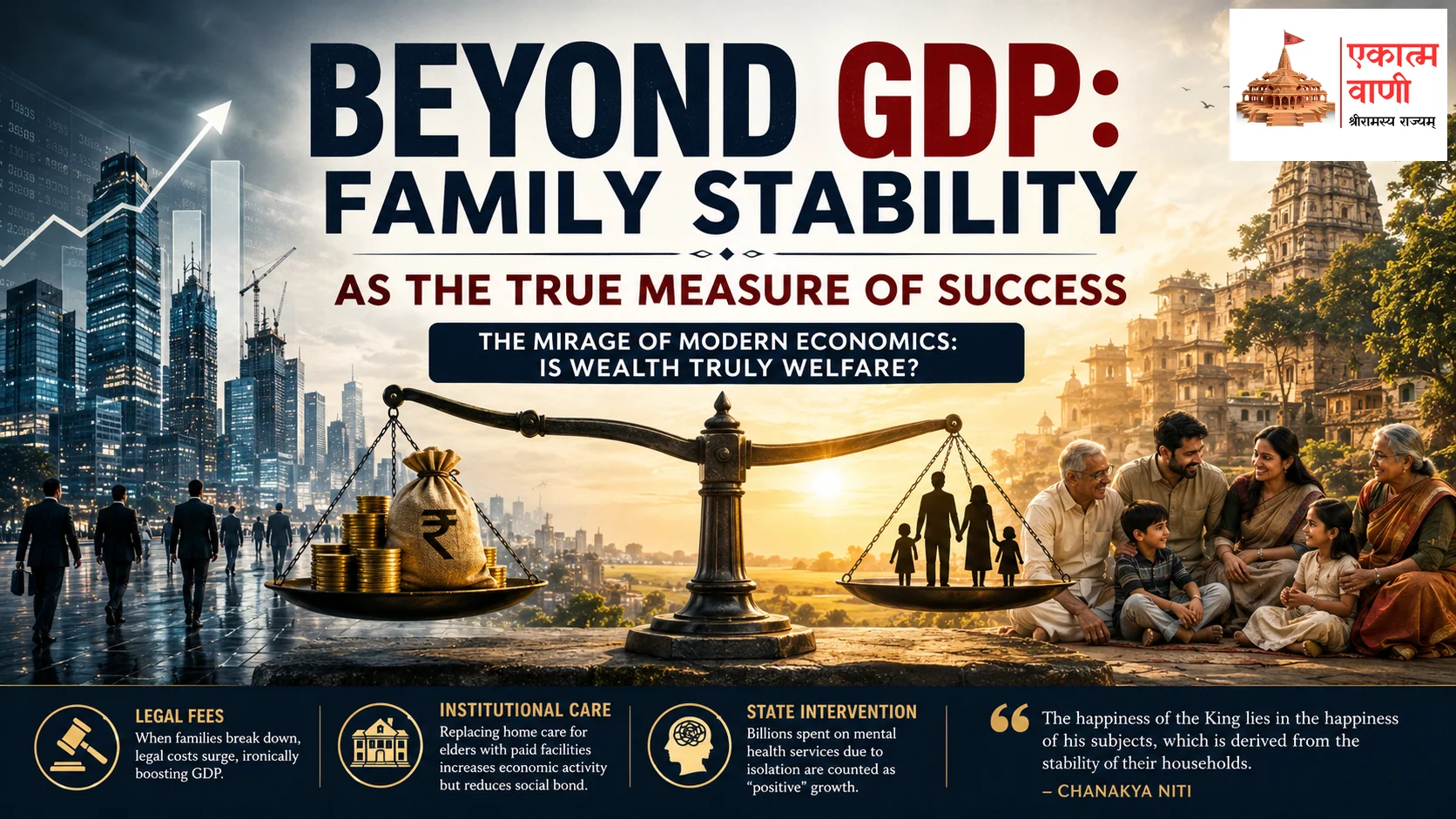
When families break down, legal costs surge, ironically boosting GDP figures.
Replacing home care for elders with paid facilities increases economic activity but reduces social bond.
Billions spent on mental health services due to isolation are counted as "positive" growth.
The core reason for our current social malaise is that our policy and executional strategies have been deeply influenced by a colonial mindset that views "progress" through a Eurocentric lens. This approach prioritises transactional efficiency over relational depth. In the West, economic growth is often pursued at the cost of the social fabric. When a family breaks down and enters the legal system for divorce, GDP increases due to legal fees. When parents place their elderly in care homes rather than caring for them at home, GDP rises. This is a perverse incentive structure where social decay generates economic activity. We are blindly aping a system where the destruction of the family unit is monetised, ignoring the fact that for Bharat, the family is not just a social arrangement but the very fortress of our civilisation.
The Bharatiya Way: Prosperity through Dharma
In contrast to the fragmented Western view, Ancient India offered a holistic, integrated approach to prosperity. Our ancestors understood that wealth (Artha) was necessary, but it was never an end in itself. It was one of the four Purusharthas, balanced intricately with Dharma, Kama, and Moksha. In this framework, economic activity was subservient to the maintenance of the social order.
The ancient Indian economic model was centred around the joint family system and the autonomous village republic. Here, social security was not a state handout but an organic outcome of strong family bonds. Elders were revered, not institutionalised; children were raised by a community, not just a nuclear pair or paid help. The measurement of success was the stability of the Kula and the contentment of the Jana, not merely the gold in the treasury. We have examples from the Mauryan and Gupta eras where Bharat commanded the lion's share of the global economy, yet the literature of the time speaks more of moral governance and societal happiness than of exploitative accumulation.
"The happiness of the King lies in the happiness of his subjects, which is derived from the stability of their households."
— Chanakya Niti
Contemporary Evidence: The Fallacy of Wealth without Warmth
If we look around the world today, the cracks in the GDP model are undeniable. Consider the affluent nations of the West or the highly industrialised societies of East Asia. They boast immense GDP per capita, yet they are in the grip of a loneliness epidemic. Japan faces the crisis of Kodokushi, and the UK has had to appoint a Minister for Loneliness. These are societies where the "standard of living" is high, but the "standard of life" is plummeting.
Conversely, look at the resilience of the Indian society during global recessions. It was the family savings and the safety net of the joint family that absorbed the shocks which devastated individualistic Western economies. In Bharat, despite lower per capita income compared to the West, the suicide rates in traditional, tight-knit rural communities often remain lower than in hyper-urbanised zones where Western lifestyles have taken root. This proves that emotional security and family stability act as a buffer against economic volatility—a value that GDP is utterly incapable of measuring. A nation where families are intact, where divorce is an anomaly rather than a norm, and where children grow up with the wisdom of grandparents, possesses a wealth that no stock market can replicate.
Ekatma Manav Darshan: The Path to Integral Happiness
To chart a new course, we must turn to the indigenous philosophy of Ekatma Manav Darshan, propounded by Pandit Deendayal Upadhyaya. This philosophy rejects the binary of Capitalism and Communism, both of which are materialistic. Instead, it proposes an "Integral Economic Dimension".
According to this view, an individual is not an isolated island but is connected to the family, the society, the nation, and the universe in an expanding spiral of consciousness. Deendayal-ji argued that a system that fuels economic growth by breaking families is inherently violent and unstable. He posited that the "Chiti" of Bharat is fundamentally different from the West. For us, Dharma sustains the society. In the context of economics, this means that if a nation's GDP is rising but its divorce rates are skyrocketing, its children are alienated, and its elderly are abandoned, that nation is not rising; it is dying. Ekatma Manav Darshan demands metrics that value the unpaid labour of women who build homes, the wisdom transferred by elders, and the stability provided by marital fidelity. These are the true pillars of national strength.
Conclusion: A Return to Roots for a Sustainable Future
In conclusion, the time has come for Bharat to shed the colonial baggage of measuring its worth through the eyes of Western economists. The GDP model is a deceptive mirage that celebrates consumption while ignoring the erosion of the very social structures that make life worth living. As a civilisational state, we must pioneer a new index—one that champions Family Stability, Spiritual Contentment, and Integral Unity.
We must adopt the wisdom of Ekatma Manav Darshan, recognising that a nation is only as strong as its families. If the hearths of our homes are cold, the fires of our factories mean nothing. Let us build a Bharat where success is not just counted in currency notes, but in the laughter of children, the blessings of elders, and the indissoluble bond of the family. This is the only way to achieve true Ram Rajya.
 Continue With Google
Comments (0)