
The Illusion of Infinite Wants
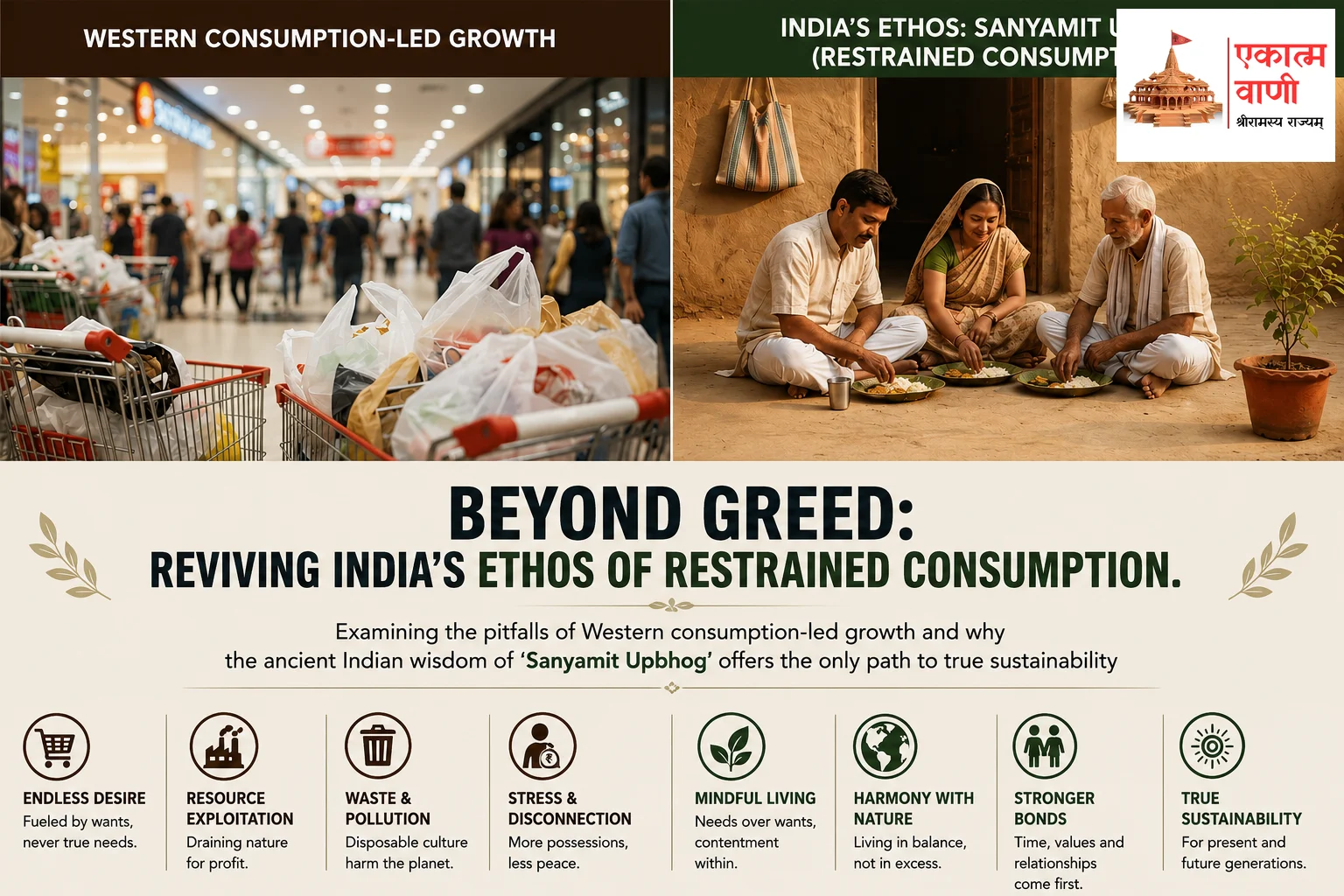
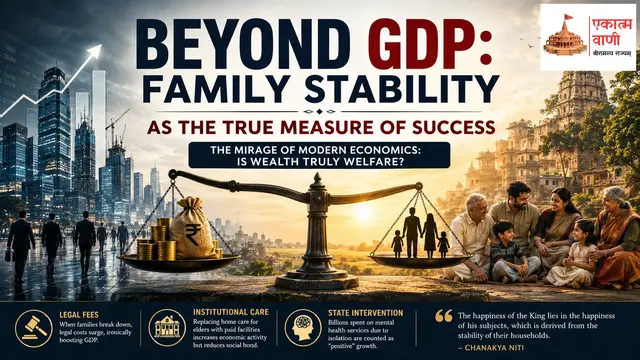
For decades, modern economists—parroting theories imported from the West—have peddled a singular narrative: that the health of a nation is measured solely by how much its citizens buy, consume, and discard. We are told that consumption-led growth is the engine of prosperity. Advertisements bombard the Indian consciousness, equating happiness with material acquisition, turning a civilization of seekers into a market of buyers.
But as we stand at the precipice of environmental degradation and social hollowness, we must ask: Is this truly the path to Abhyudaya (prosperity)? The modern economic model promises satisfaction through saturation, yet looking at the rising mental health crises, mounting household debt, and ecological devastation, one is forced to ask: Has this relentless pursuit of 'more' actually fulfilled the deeper purpose of human existence?
The Diminishing Returns of Consumption
Fig 1. Generalized representation of studies showing that beyond a basic threshold, increased material consumption does not correlate with increased happiness, often leading to a plateau or decline in well-being.
The Western Myopia in Indian Policy
The tragedy lies not just in the failure of consumerism, but in our blind adoption of it. The promise of fulfillment remains broken because the core philosophy driving our current economic policies is fundamentally alien to the Indian psyche. Since liberalization, and perhaps even before, our policymakers have been intellectually colonized by Western thought processes that view humans merely as Homo Economicus—beings driven solely by utility and profit.
This Western model thrives on artificial demand creation, convincing people to buy things they do not need with money they do not have. It is a system designed for the atomic individual, devoid of community or spiritual responsibility. By ignoring our civilizational imperative which values contentment (Santosh) over accumulation, we have imported a model that breeds inequality and restlessness, mistaking the fever of GDP growth for the health of the nation.
75%
of GDP
Household debt in nations like the US, highlighting the instability of consumption fueled by credit.
High
Household Savings
The hallmark of the traditional Indian economy, acting as a resilient buffer against global volatility.
The Dharmic Economy: Wisdom of the Ancients
It was not always so. Ancient India, or Bharat, was the economic powerhouse of the world for millennia, contributing to a third of global GDP not through rapacious exploitation, but through a Dharmic Economy. Our ancestors understood that Artha (wealth) is a vital pursuit, but it must be governed by Dharma (righteousness) and limited by the understanding that material pleasure (Kama) is not the ultimate end.
Ancient India's Economic Might
Fig 2. Historical estimates suggest Ancient India contributed up to 33% of Global GDP, driven by a sustainable, Dharmic economic model.
"Sanyamit Upbhog"
The concept was never poverty; it was Restrained Consumption. In the Arthashastra and the Mahabharata, wealth was seen as a resource to be circulated for the welfare of all (Lokasamgraha), not hoarded for individual gratification. The merchant was a trustee, not an owner.
This balance ensured that while India was incredibly wealthy, it was also sustainable, respecting nature (Prakriti) as a mother, not a warehouse of raw materials.
Beacons of Sustainability
Even today, amidst the noise of malls and e-commerce, we see flashes of this indigenous wisdom working where Western models fail. Consider the traditional Indian practice of the Circular Economy—which is just a modern rebranding of our grandmother’s habits of repairing, reusing, and repurposing. Look at the stark contrast between the use-and-throw culture of the West and the Indian ethos of maximizing the utility of every object.
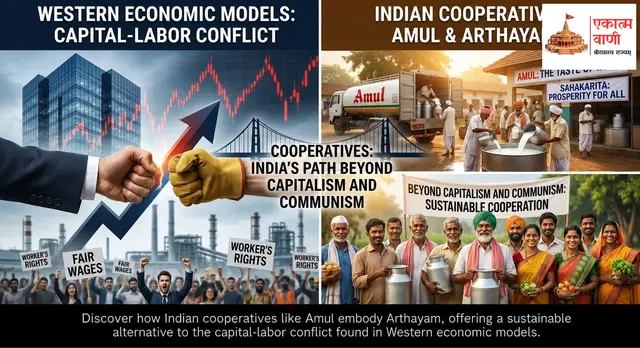
Furthermore, successful cooperative models in India, such as the original vision of Amul or the Lijjat Papad enterprise, were built not on maximizing shareholder greed, but on collective welfare and sustainable production. These examples prove that economic scale does not require the destruction of values. They succeed because they align with the natural Indian tendency towards cooperation and restraint rather than hyper-competitiveness and excess.
| Aspect | Western Model (Homo Economicus) | Dharmic Model (Indian Ethos) |
|---|---|---|
| Driver | Utility, Profit, Artificial Demand | Dharma (Righteousness), Needs (Finite) |
| Nature | Warehouse of raw materials | Prakriti (Mother), Extension of Self |
| Consumption | Use-and-throw, Status-driven | Circular (Reuse/Repair), Sanyamit Upbhog |
| Goal | Individual Gratification | Lokasamgraha (Welfare of All) |
Table 1: A structural comparison between the prevailing Western economic model and the indigenous Dharmic approach.
Insights from Ekatma Manav Darshan
To truly correct our course, we must revisit the philosophy of Ekatma Manav Darshan (Integral Humanism) propounded by Pt. Deendayal Upadhyaya. He brilliantly argued that a system based on "Survival of the Fittest" is animalistic; human culture begins with cooperation. Upadhyaya ji warned explicitly against the "limitless expansion of wants." He posited that while the West views nature as an enemy to be conquered, Indian thought views nature as an extension of the self.
True development integrates:
According to Integral Humanism, an economy that encourages unrestrained consumption eventually eats into the vitals of the society. He advocated for Swadeshi and decentralization, ensuring that consumption is aligned with local production capacities, thereby preventing the exploitation that is inherent in globalized, consumption-led supply chains.
Data for Reflection: The Cost of Greed
To visualize the disparity between these two worldviews, consider the ecological impact.
Ecological Footprint: Earths Needed
Analysis: If the entire world consumed at the rate of an average American, we would need 5 Earths. Conversely, if the world consumed like the traditional Indian household, we would arguably be within the planet's regenerative capacity (approx. 0.8 to 1 Earth).
Conclusion: The Return to Sanatan Economics
We stand at a crossroads. We can continue to run on the hedonistic treadmill of the West, destroying our environment and our peace of mind in a race we cannot win. Or, we can assert our civilizational identity. Sanyamit Upbhog is not about going back to the stone age; it is about moving forward with wisdom.
"It is the realization that Needs are finite, but Greed is infinite."
For India to lead the world—to become a Vishwaguru—it must not copy the failing economic models of the West. It must present a model of Sustainable Development rooted in restraint, where the economy serves Dharma, and prosperity is measured not by what we consume, but by what we conserve and cherish.
 Continue With Google
Comments (0)