

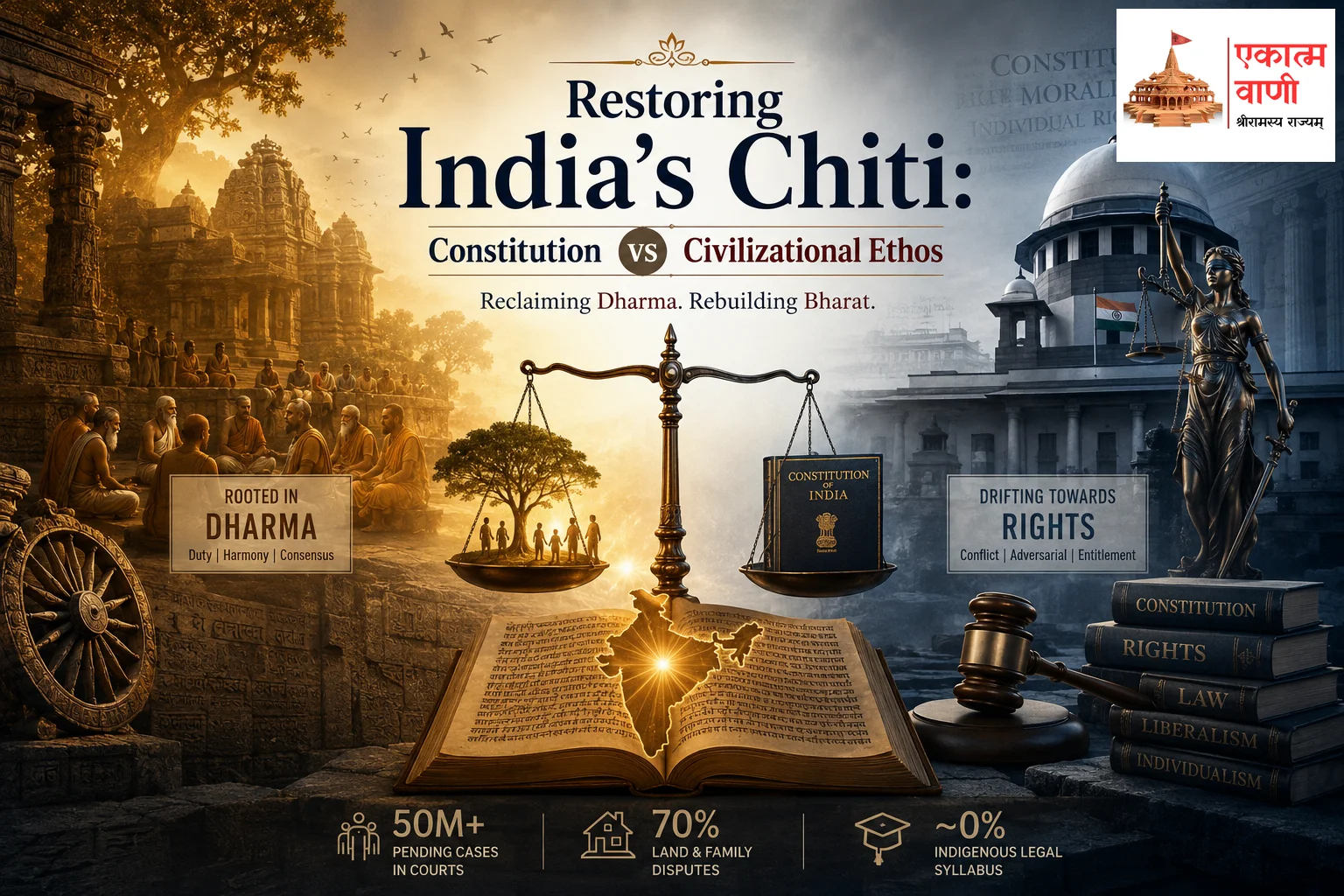
For over seven decades, the Republic of India has been governed by a Constitution often celebrated as a living document, a bastion of modern liberal democracy. Yet, beneath the veneer of this legal framework lies a profound and unsettling silence—the silence of the Bharatiya Chiti. While we, as a nation-state, adopted the Westminster model and a rights-based jurisprudence in 1950, we seem to have inadvertently distanced ourselves from the civilizational ethos that sustained Bharat for millennia.
The question that confronts the nationalist thinker today is not merely about the efficacy of our laws, but about their very soul. Are we a civilization pretending to be a nation-state defined solely by a post-colonial document, or are we an eternal civilization seeking to express its ancient wisdom through modern governance? The tension between 'Constitutional Morality'—a phrase frequently brandished by the judiciary to override traditional values—and the innate 'Civilizational Ethos' of the land is palpable.
The Constitutional Promise and the Missing Soul
The drafting of the Indian Constitution was a monumental task, intended to unify a diverse land and steer it toward justice, liberty, equality, and fraternity. The purpose was clear: to create a framework that would facilitate the governance of a newly independent nation while rectifying the social inequities of the past. It was envisioned as a tool for social engineering, a mechanism to transform a hierarchical society into a modern egalitarian one.
However, as we stand in the third decade of the 21st century, we must pause and reflect on the efficacy of this purpose. Has the legal framework fostered a society that is at peace with its heritage, or has it created a schizophrenic existence where the law pulls Westward while the spirit yearns for the East? The growing dissonance between court verdicts and community sentiments suggests a deep-seated malaise.
Figure 1: The current legal system heavily outweighs Individual Rights over Dharmic Duties.
Ideally, a constitution should be the codified manifestation of a people's culture, aspirations, and historical wisdom. It should reflect the Chiti—the unique life-force or soul—of the nation. Yet, our current focus remains heavily skewed towards individual entitlement rather than the collective good.
The Western Shadow Over Bharatiya Governance
The primary reason for this unfulfilled purpose lies in the genesis of our constitutional framework. It is an open secret that the Indian Constitution is, in many respects, a "bag of borrowings." While the drafting committee included brilliant minds, the intellectual climate of the time was heavily dominated by Western liberalism, Fabian socialism, and the legacy of British jurisprudence.
| Feature | Western Model | Sanatan (Indic) Model |
|---|---|---|
| Core Unit | Individual (Atomic) | Samaj / Community |
| Focus | Rights (Adhikar) | Duty (Dharma) |
| Justice Style | Adversarial (Win/Lose) | Consensus (Harmony) |
| View on Nature | Resource to exploit | Sacred entity to protect |
Table 1: Fundamental divergences between Western legal theory and Indian ethos.
In the Western model, the state is the ultimate arbiter, and rights are claims made by the individual against the state or society. In the Sanatan worldview, however, the focus is on Dharma—the cosmic order and duty that sustains the universe. By importing a legal system that thrives on adversarial conflict rather than consensus and harmony, we have created a litigious society.
Governance in Ancient India: The Sovereignty of Dharma
To understand the magnitude of our deviation, we must look rationally at how governance was conducted in ancient India. Unlike the Western concept of the "Divine Right of Kings" or the modern concept of "Parliamentary Sovereignty," ancient India operated on the supremacy of Dharma. The King (Raja) was not the source of law but merely its enforcer.
In the Vedic and post-Vedic eras, governance was decentralised. The Janapadas and Mahajanapadas functioned with a high degree of autonomy. The village assemblies (Sabhas and Samitis) were the primary units of administration, ensuring that justice was swift, local, and restorative rather than punitive.
Figure 2: Time taken to resolve disputes: Modern Courts (Years) vs Ancient Panchayat System (Days).
The concept of Rta (Cosmic Order) underpinned all human laws. A king who violated Dharma could be removed by the sages or the people, as seen in the legend of King Vena. The governance model was "Bottom-Up," where the Kula (family), Jati (community), and Grama (village) managed their own affairs.
Glimmers of Hope: Harmony in Action
Despite the overarching Western framework, there have been instances where the Bharatiya spirit has successfully asserted itself. These examples serve as beacons for the future:
- Juristic Personhood for Deities: The Ram Janmabhoomi case recognized the Divine as a legal entity, bridging secular law and faith.
- Article 48 (Cow Protection): Acknowledges the agricultural and spiritual centrality of the cow in Indian ethos.
- Bharatiya Nyaya Sanhita: A shifting intent to replace colonial codes, centering victim justice (Nyaya) over mere procedure.
Ekatma Manav Darshan: The Philosophical Compass
To truly resolve the conflict between Constitutional Morality and Civilizational Ethos, we must turn to the indigenous political philosophy of Ekatma Manav Darshan (Integral Humanism), propounded by Pt. Deendayal Upadhyaya.
Understanding Integral Humanism
Unlike fragmented Western ideologies (Capitalism/Communism), this philosophy views the human being as an integrated whole comprising:
Upadhyaya ji argued that a nation is not just a piece of land or a political agreement; it is a living entity with a soul (Chiti) and a body force (Virat). A true Bharatiya constitution would focus on Dharma which sustains all entities in harmony.
Data for Review: The Cost of Disconnect
To visualize the inefficiency of the current imported system versus a potential indigenous model, we can look at specific indicators that highlight the friction. The breakdown of the Samaj (community mediation) forces people to impersonal courts.
Figure 3: Composition of Civil Litigation in India.
Judicial Pendency: The adversarial Western model is collapsing under its own weight. A traditional Panchayat/Mediation model resolves disputes faster.
Social Alienation: A staggering percentage of civil cases involve land and family disputes—issues historically resolved by community elders, now clogging the formal justice system.
Education Gap: There is a near-zero focus on indigenous legal theory in law schools, leading to a generation of lawyers disconnected from the land's ethos.
Conclusion
The dialogue between the Indian Constitution and the Bharatiya Chiti is not merely an academic exercise; it is a struggle for the survival of our civilizational identity. While the Constitution has served as a functional rulebook for the Republic, it has often failed to act as a mirror to the soul of the nation.
Harmony cannot be established by discarding our heritage in favour of a hollow modernity. Instead, we must strive for a "Dharmic Constitutionalism." This does not mean a theocratic state, but a state where the laws are rooted in the soil of Bharat—laws that value duty over entitlement, community over hyper-individualism, and restorative justice over adversarial retribution. The search for India's Chiti will only end when our Constitution ceases to be just a legal document and becomes a true Dharma Shastra for the modern age.
 Continue With Google
Comments (0)