
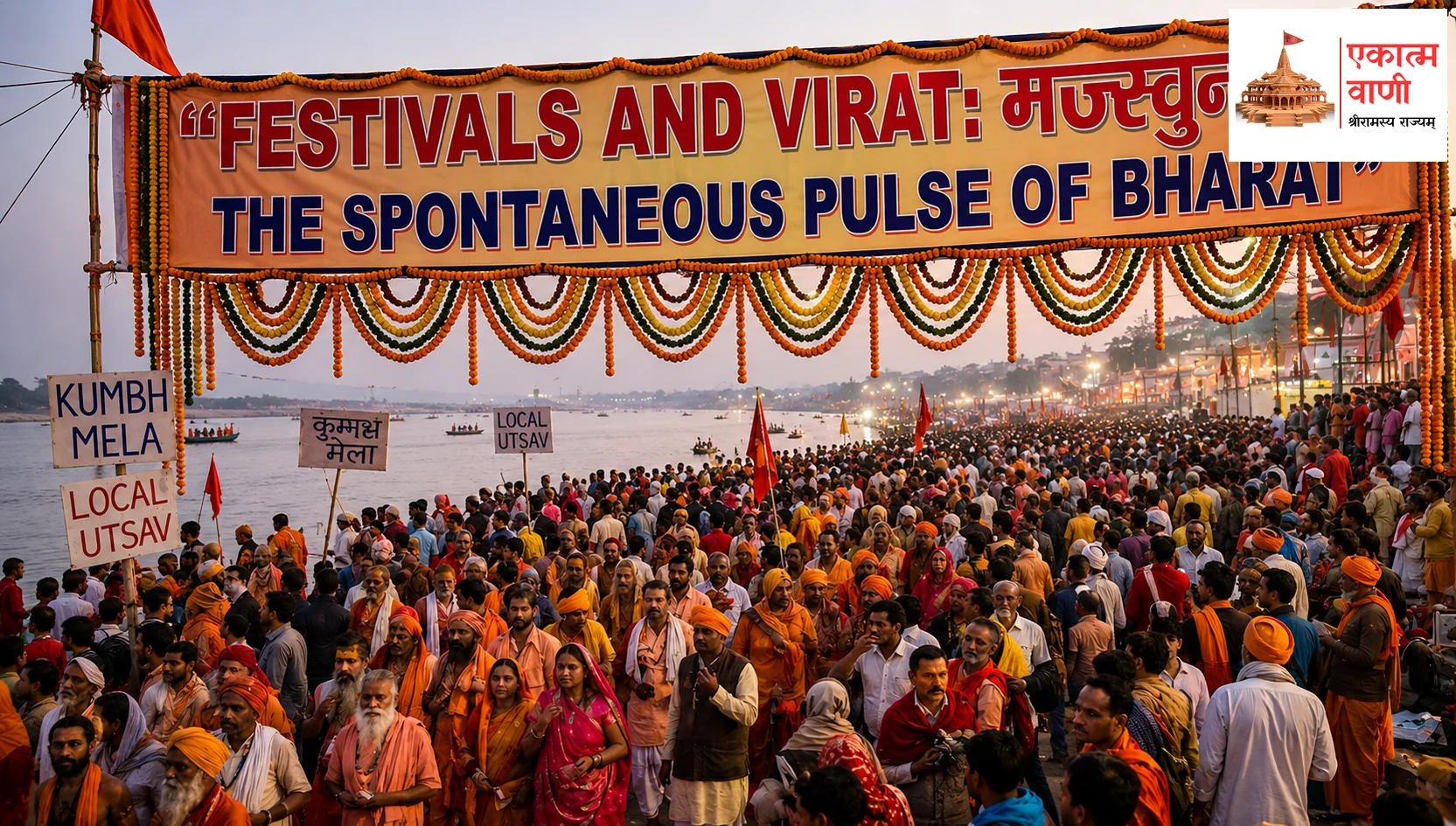
To understand Bharat is to look beyond the geopolitical definition of a nation-state. It is to witness a living, breathing civilizational entity that functions not on the mechanics of constitutionality alone, but on the rhythmic heartbeat of its festivals. These gatherings are not merely dates on a calendar; they are the resplendent expressions of our collective soul.
Defining the Core Concepts:
Chiti: The innate nature or soul of the nation.
Virat: The collective power and consciousness of society.
The Purpose of Festivals: Awakening the National Soul
The fundamental purpose of festivals in the Bharatiya context is to manifest the ‘Chiti’—the innate nature of the nation—and awaken the ‘Virat’, the collective power of society. A festival in India is designed to be a sociological instrument that dissolves class, caste, and regional boundaries, unifying the individual with the aggregate. It is meant to be a voluntary, organic submission to a higher Dharma, where the collective consciousness takes precedence over individual ego. The vibrancy of a local village fair or the grandeur of the Kumbh is not just about commerce or ritual; it is about reinforcing the civilizational bond that holds this vast land together. However, as we survey the modern landscape of event management and state-controlled temple boards, we must ask the uncomfortable question: Is this profound civilizational purpose truly being fulfilled in contemporary India?
The Western Lens vs. The Ancient Way
Regrettably, the answer often leans towards the negative, and the reasons are deeply rooted in a colonial hangover that plagues our administrative machinery. The modern Indian state, heavily influenced by Western thought processes, views these spiritual congregations through the lens of "crowd management" and "law and order" rather than as organic social phenomena.
| The Western Administrative Lens | The Ancient Bharatiya Way |
|---|---|
| Focus on "Crowd Management" & "Law and Order". | Focus on Dharma as a self-sustaining moral order. |
| State acts as a Regulator/Controller. | State acts as a Facilitator; Society organizes itself. |
| Events viewed as "Tourism Products". | Events viewed as manifestations of Seva (Service). |
| Sterile, secularized, bureaucratic execution. | Organic, spiritual spontaneity led by Sampradayas. |
The policy and executional strategies opted for are sterile, secularised, and bureaucratic. We see a concerted effort to sanitise these festivals, stripping them of their raw, spiritual spontaneity and repackaging them as "tourism products" for global consumption. When the state steps in not as a facilitator but as a regulator, imposing rigid Western frameworks of governance on fluid Eastern traditions, the spiritual ecosystem is disrupted. The organic unity is replaced by artificial control, stifling the natural breathing rhythm of the Virat.
The Manifestation of Virat: The Kumbh Phenomenon
"The administration does not create the Kumbh; the Kumbh creates itself... This spontaneous assembly proves that the Indian nation is held together not by the iron fist of the state, but by the invisible, golden thread of cultural unity."
This brings us to the most potent example of our key premise: the Kumbh Mela. Here, we witness a sociological miracle that defies Western logic. Without a single central government order, invitation, or marketing campaign, crores of people descend upon a riverbank at a specific planetary alignment. Who invites them? It is the call of the Virat. The Kumbh Mela—and indeed, local melas across the hinterland—are spontaneous manifestations of the nation's collective consciousness.
The sadhus, the akharas, and the common devotee operate on an unwritten code of conduct that creates order out of apparent chaos.
Philosophical Roots: Ekatma Manav Darshan
This phenomenon finds its theoretical grounding in the philosophy of Ekatma Manav Darshan (Integral Humanism), propounded by Pandit Deendayal Upadhyaya. Upadhyaya Ji articulated that a nation has a soul (Chiti) and a body (Virat). He argued that while the State is a political institution, the Nation is a cultural reality. Western ideologies like Capitalism (focusing on the individual) or Communism (focusing on the class) fail to grasp the organic unity of Bharatiya society. In his view, festivals are the moments when the Virat is most visible—when the "me" dissolves into the "we". The spontaneous participation of the masses in these events is the practical application of Integral Humanism, where the individual finds fulfillment not in isolation, but in the harmonious integration with society, nature, and the divine.
Data and Figures: The Scale of the Sublime
The sheer magnitude of these events renders them statistically incomparable to anything in the West.
Economic Impact (2019)
₹1.2 Lakh Cr
Revenue generated (CII Estimate)
Central Invites Sent
ZERO
Total spontaneous organization
Maha Kumbh 2025
50 Crore
Projected Attendance
Figure 1: Exponential growth in Kumbh Mela attendance from 2019 to 2025 projections.
Footfall:
The 2019 Kumbh Mela witnessed an estimated 24 crore (240 million) visitors. Projections for the Maha Kumbh 2025 suggest a staggering 45 to 50 crore attendees.
Global Context:
To visualize the scale, the expected gathering for the 2025 Maha Kumbh is essentially the combined population of the USA, UK, and Russia gathering in one city.
Figure 2: Maha Kumbh 2025 projected attendance vs. total populations of major nations (in Millions).
Economic Impact: Far from being a drain on resources, these festivals are economic engines. The Confederation of Indian Industry (CII) estimated the 2019 Kumbh generated a revenue of ₹1.2 lakh crore. Furthermore, thousands of social organisations run Bhandaras (community kitchens), feeding millions daily without a rupee of government subsidy, showcasing the economic might of social charity.
Conclusion
To conclude, festivals in India are not mere holidays; they are the sociological spine of the nation. They demonstrate that Bharat is capable of immense, peaceful, and productive self-organization without the need for the heavy hand of a central command. As we move forward, it is imperative that we shed the colonial lens of viewing these events as "problems to be managed" and embrace them as the "solutions" that sustain our national integrity. We must return to the ancient wisdom where the state facilitates, but the Virat leads. Only then can we truly claim to be a civilisational state in the modern world.
 Continue With Google
Comments (0)