

In the discourse of modern education, language is often treated as a neutral tool, a simple vehicle for transferring data. However, this utilitarian view ignores the deep connection between a language and the people who speak it. A language carries the historical memory, the values, and the unique worldview—the Chiti—of a civilization. The imposition of foreign languages as the primary medium of instruction has created a silent crisis, affecting everything from cognitive development to social equity.
Across the globe, the push for homogenization has left a staggering number of children alienated from their own education. According to UNESCO, the disparity is not just a matter of preference but a fundamental violation of educational rights.
When 40% of the world cannot understand the language used in their classrooms, schools cease to be places of learning and become centers of exclusion. This linguistic barrier serves as the first and most formidable gatekeeper, preventing millions from realizing their potential.
The impact of this disconnect is measurable. Learning in a foreign language forces the brain to perform a double translation—first decoding the language, then processing the concept. This cognitive load significantly hampers critical thinking and creativity.
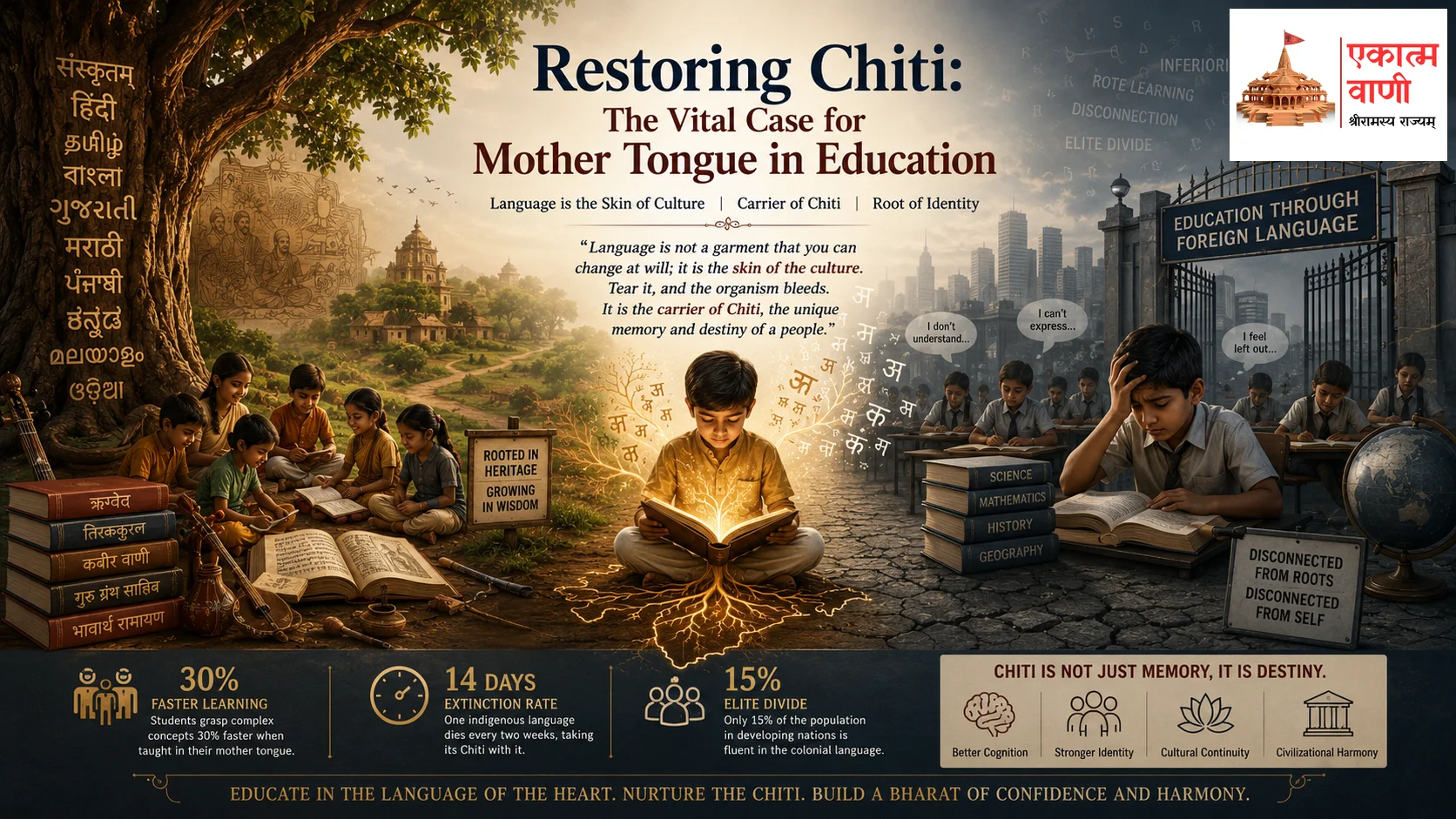
Students grasp complex concepts 30% faster when taught in their mother tongue.
One indigenous language dies every two weeks, taking its Chiti with it.
Only 15% of the population in developing nations is fluent in the colonial language.
The disparity becomes even more evident when we examine learning outcomes. Students forced to rote-learn in a foreign tongue often struggle to retain information or apply it creatively. In contrast, mother tongue education fosters deep conceptual clarity.
To understand why this matters, we must distinguish between language as a tool and language as identity. In the Indian context, this is the concept of Chiti—the collective soul or consciousness of a society.
"Language is not a garment that you can change at will; it is the skin of the culture. Tear it, and the organism bleeds. It is the carrier of Chiti, the unique memory and destiny of a people."
Sees language as interchangeable data. Prioritizes global standardization and economic utility over cultural depth. Views the mother tongue as "baggage."
Sees language as a living repository of values. Prioritizes wisdom, heritage, and continuity. Views the mother tongue as the "root" of the tree.
The imposition of a foreign language creates fractures across multiple dimensions of society. It is not merely an academic issue; it is a structural inequality that manifests in three distinct layers.
| Layer | Impact of Foreign Language | Result |
|---|---|---|
| Psychological | Internalization of inferiority | Loss of self-confidence and originality |
| Societal | Creation of elite vs. masses | Exclusion of the majority (85%) from power |
| Civilizational | Severing link to ancestry | Cultural amnesia and loss of Virat (Harmony) |
Perhaps the most insidious effect is the gradual erosion of cultural connection over generations. As vocabulary in the mother tongue shrinks, so does the ability to access native philosophy, literature, and family history.
The data suggests a disturbing trend: with each generation educated primarily in a foreign language, the connection to the root culture diminishes, leading to a state of permanent alienation.



 Continue With Google
Comments (0)