
The Mirage of Modern Medicine: Have We Truly Achieved Health?
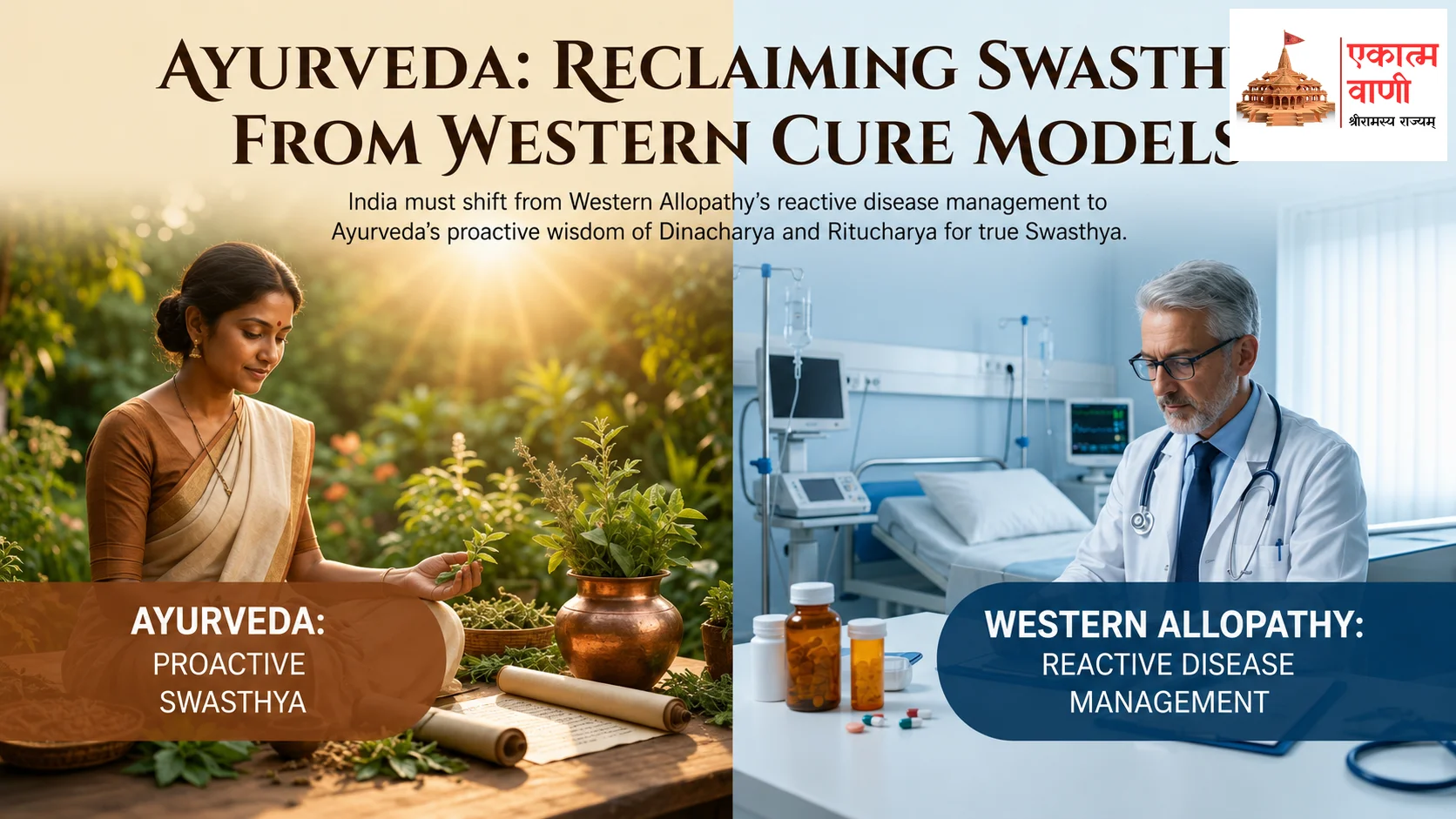
In the cacophony of modern development, India stands at a critical juncture regarding the most fundamental aspect of human existence: health. For decades, the narrative of healthcare in our nation has been dominated by a singular, imported worldview—Modern Allopathy. This system, predominantly reactive in nature, focuses almost exclusively on Rog Upachar (Disease Treatment). It views the human body as a biological machine and illness as a mechanical breakdown requiring chemical intervention. In stark contrast stands the eternal wisdom of this land, Ayurveda, which prioritises Swasthya Rakshanam (Health Protection). The fundamental premise of Ayurveda is not merely to cure the sick, but to preserve the health of the healthy.
As we construct more super-specialty hospitals and import expensive medical technologies, we must pause and ask: Are we creating a healthier society, or simply a society better equipped to manage sickness? The purpose of any robust national health policy should be the cultivation of vitality and the prevention of suffering. However, looking at the exponential rise in lifestyle diseases among the youth and the elderly alike, one is forced to confront an uncomfortable truth. despite the proliferation of pharmaceuticals and the glorification of Western medical protocols, the holistic well-being of the Bharatiya citizen is deteriorating. The question that demands an urgent answer from our policymakers is simple yet profound: Is the fundamental purpose of our health infrastructure truly fulfilled?
India's Critical Status
Citizens currently living with Diabetes, making India the "Diabetes Capital of the World."
(Source: ICMR-INDIAB Study)The Colonial Hangover: Why We Are Failing
The reason for this glaring failure is not a lack of resources, but a lack of vision rooted in indigenous consciousness. The failure to achieve true Swasthya stems from a policy and executional strategy that is heavily intoxicated by Western thought processes. Since independence, our health policies have been largely cut-and-paste jobs from European and American models, which are designed for societies with entirely different consumption patterns, climates, and cultural fabrics. We have adopted a "fire-fighting" approach to health—waiting for the body to collapse before intervening—rather than the "fire-proofing" approach of our ancestors.
"In the Western model, a patient is a customer; a cured patient is a lost customer. Therefore, the system thrives on the management of disease rather than its eradication."
The core reason for this disconnect is the intellectual colonization that persists in our administrative corridors. We have allowed the commercial interests of the global pharmaceutical complex to dictate our definition of health. By blindly mimicking this model, India has marginalized its own scientific heritage. We have dismissed the profound science of lifestyle as "grandma's tales" while swallowing the bitter pill of side-effect-laden chemicals. We have failed because we tried to impose a reductionist, materialistic framework on a civilization that inherently understands the body as a complex interplay of energies (Doshas). We are failing because we are treating the smoke while ignoring the fire.
| Parameter | Western Allopathy | Ayurveda |
|---|---|---|
| Core Approach | Reactive (Fire-fighting) | Preventative (Fire-proofing) |
| View of Body | Biological Machine | Interplay of Energies (Doshas) |
| Goal | Rog Upachar (Disease Treatment) | Swasthya Rakshanam (Health Protection) |
The Ancient Blueprint: Science of Daily Living
To understand how health was engineered in ancient India, one must look beyond the mortar and pestle to the clock and the calendar. Our ancestors did not view health as a series of doctor visits; they viewed it as a disciplined way of life. This was achieved through the scientifically rigorous frameworks of Dinacharya (Daily Regimen) and Ritucharya (Seasonal Regimen). In the golden era of Bharatiya civilization, health was not an external commodity but an internal discipline.
Dinacharya was not merely a routine; it was a synchronization of the biological clock with the cosmic rhythm. It included practices designed to maintain equilibrium.
Brahma Muhurta
Pre-dawn awakening to harness high ozone levels and Sattvic energy.
Gandusha
Oil pulling techniques specifically for oral hygiene and detox.
Abhyanga
Self-massage routines to promote lymphatic drainage.
Vyayama
Exercise limited to half-capacity to build endurance without burnout.
Similarly, Ritucharya dictated dietary and lifestyle adjustments based on the movement of the sun and the resulting climatic changes. For instance, consuming cooling foods in Grishma (Summer) and heating, unctuous foods in Hemanta (Winter) was not culinary preference but preventative medicine. This was a rational, observation-based science designed to keep the Tridoshas (Vata, Pitta, Kapha) in equilibrium, ensuring that disease found no soil in which to take root.
Historical Excellence: When Prevention Was Culture
History is replete with examples where this model was executed with flawless precision. Consider the traditional Bharatiya kitchen, which was effectively the primary pharmacy of the household. The use of spices was never for taste alone but for their pharmacological properties—turmeric as an anti-inflammatory, cumin for digestion, and ginger for immunity. This was preventative healthcare integrated into culture.
We can look to the disciplined lives of the Akhadas and traditional wrestling communities, where the diet and sleep schedules were strictly regulated to produce bodies of iron, free from the lifestyle diseases that plague modern gyms. Furthermore, the monastic traditions and the lives of the Rishis exemplified the pinnacle of this wisdom. They lived for over a century not because of medical intervention, but because their lifestyle was in perfect harmony with nature. Even in administration, ancient kingdoms prioritized public baths, sanitation, and the planting of medicinal herbs along highways, proving that the state understood its role in facilitating a healthy environment rather than just treating the sick.
Ekatma Manav Darshan: The Philosophical Anchor
To truly restructure our health policy, we must turn to the guiding light of Ekatma Manav Darshan (Integral Humanism), propounded by Pt. Deendayal Upadhyaya. This philosophy rejects the fragmented Western view of human life. Upadhyaya ji articulated that a human being is not merely a physical body but an integrated entity.
Western medicine often treats the body while neglecting the mind and ignoring the soul, leading to a superficial cure that often results in psychosomatic recurrence. Ekatma Manav Darshan teaches us that true development—and by extension, true health—cannot be achieved if these four aspects are in conflict. A health policy inspired by this philosophy would not just fund hospitals; it would fund yoga centers, meditation halls, and organic farming. It would recognize that feeding the population chemically grown food while treating them with chemical medicines is a violation of the "whole." Just as the individual is linked to society, the body is linked to nature.
The Cost of Ignorance: Data for Reflection
The following data points illustrate the urgent need for a paradigm shift. These inputs can be visualized to understand the gravity of our reliance on the wrong model. The Diabetes Explosion is a direct result of abandoning Dinacharya. Non-Communicable Diseases (NCDs) like heart disease and hypertension now contribute to over 60% of all deaths in India.
Fig 1. Proportion of deaths in India caused by Non-Communicable Diseases.
Fig 2. Annual monetary burden: Allopathy vs. Dinacharya.
Doctor-Patient Ratio: We are chasing the WHO norm of 1:1000 doctors. However, if we empowered every citizen with Ayurveda’s preventative knowledge, the demand on doctors would drastically decrease, making this metric less critical.
Conclusion: The Path to Vishwaguru Requires Swasthya
In conclusion, the trajectory of India’s health policy must undergo a radical nationalist correction. We cannot aspire to be a Vishwaguru (World Leader) with a population that is physically frail and dependent on foreign pharmaceutical patents. The blind aping of Western Allopathy has given us a system that manages disease but has forgotten how to nurture health.
We must move from a "Standard of Living" approach (consumption-based) to a "Standard of Life" approach (well-being based).
It is time to integrate Dinacharya and Ritucharya not just into our personal lives, but into our national curriculum and health policy. We must move from the lucrative business of 'Cure' to the sacred duty of 'Care.' By embracing our indigenous wisdom and rejecting the colonial mindset that views our heritage as inferior, we can build a Swasthya Bharat that is robust, self-reliant, and truly liberated. The path forward is not new; it is ancient. We only need the courage to walk it again.
 Continue With Google
Comments (0)